Last updated 2026-08-18
TL;DR
Texas has no statewide temp fence contractor license. Most operators work under a city permit or no license at all, depending on scope. Permit rules, bond amounts, and renewal timelines change from city to city. Panel rental runs $3 to $8 per panel per month statewide, with wind-bracing and installation billed on top.
Do you need a license for temp fence in Texas?
Short version: probably not a dedicated temp fence license. Longer version depends on exactly what you're doing.
Texas has no statewide specialty license for temporary fencing. The Texas Department of Licensing and Regulation (TDLR) oversees dozens of trades, but a standalone "temp fence contractor" credential does not exist at the state level [1]. That splits Texas off from states like California, where a C-13 fencing license is a hard requirement.
Scope creep is what gets people in trouble here. The moment your work involves grading, concrete footings, or permanent attachment, a general contractor or specialty license may apply depending on the city. The Texas Occupations Code Chapter 1305 licenses electricians; Chapter 1301 licenses plumbers. General contractors are not licensed statewide the same way, so the real framing is city-level [2].
Several Texas cities go further than the state. Houston, Dallas, Austin, and San Antonio each run their own contractor registration or permit rules. Houston's Construction and Development department requires contractor registration for most commercial site work, and fence installation can fall inside that depending on project value [3]. Dallas requires a permit for any fence over a set height or enclosing a set area, temporary ones on construction sites included.
Here's the move. Call the building department in every city where you plan to work. Ask directly whether a temporary construction fence on a commercial job site needs a permit, a contractor registration, or both. Get the answer in writing if you can. Never assume the rule in one city carries to the next.
Running as an LLC or corporation adds one more baseline. You register with the Texas Secretary of State and keep a registered agent on file. That's a business requirement, not a contractor license, but it matters the day you sign a contract with a GC [4].
How does the temp fence permit process work in Texas cities?
Permits for temp fence in Texas are a local game. The state sets no uniform process, so the rules live entirely at the city building department.
In Austin, the Development Services Department handles construction site fencing permits. A site safety fence permit is typically required for any project that needs a building permit and involves public sidewalk encroachment or right-of-way impacts. The fee is tied to the project's total valuation and the linear footage of fence [3].
Houston commercial projects almost always need a construction fence permit when the fence abuts a public right-of-way. You pull it through the Houston Permitting Center online portal. Turnaround on clean applications usually runs 5 to 10 business days, though that number is not guaranteed and stretches longer during high-volume stretches.
Dallas works the same way. The Dallas Development Services department issues right-of-way use permits when temp fence sits on sidewalk or street lane space. The renewal cycle tracks the construction permit itself, so when the building permit renews annually, the fence permit gets reviewed alongside it.
San Antonio runs through its Development Services Department and issues a Construction Fence Permit when fencing affects pedestrian access. Renewals are annual and tied to the project timeline.
All four cities have online permit portals now. That matters because most renewals go through without a site visit, as long as nothing about the scope changed. Grow your fence footprint or add signage to it, and you're usually looking at a new permit rather than a straight renewal.
Smaller markets follow the same logic. Lubbock, El Paso, Fort Worth, and Corpus Christi each run their own process, and the pattern holds: any fence touching a public right-of-way needs a permit, purely interior fencing on private property generally does not. Confirm with the relevant board before assuming either way.
How much does temp fence cost in Texas?
Texas temp fence pricing is competitive because the market is huge and regional suppliers are thick on the ground, especially along the I-35 corridor and in the big metros.
Panel rental is the baseline. Standard 6-foot by 10-foot chain link panels typically run $3 to $8 per panel per month depending on quantity, duration, and how remote the site is [5]. Big projects ordering 200 or more panels for six-plus months land closer to the $3 end. Small jobs in tight urban blocks with limited truck access push toward $7 to $8.
Delivery, installation, and removal get billed separately by most Texas vendors. Budget $1.50 to $3.00 per linear foot for a basic drop-and-install on flat ground. Grade changes, concrete bases, or tie-back requirements cost more.
Wind bracing is a real line item in Texas, not optional fluff. Wind events in North Texas, West Texas, and along the Gulf Coast take down an unbraced panel fence fast. Most suppliers charge $0.50 to $1.50 per panel per month for bracing kits or cable cross-bracing. Some fold basic bracing into the standard install. Ask before you assume.
Privacy screening adds $1 to $2 per linear foot per month on top of the panel rate. It shows up on urban sites in Dallas and Austin where neighboring businesses or pedestrians raise visibility complaints.
Permit fees are their own line. Based on Austin's fee schedule, a construction fence permit for a mid-sized project runs a few hundred dollars up front, with annual renewals in a similar range. The exact figure depends on valuation and linear footage, so confirm with the relevant board [3].
The table below shows representative ranges for a 100-panel temp fence job in a Texas metro.
| Cost component | Low estimate | High estimate |
|---|---|---|
| Panel rental (per month, 100 panels) | $300 | $800 |
| Delivery and installation | $500 | $1,200 |
| Wind bracing (per month) | $50 | $150 |
| Privacy screening (per month) | $200 | $500 |
| Permit fee (city-dependent) | $150 | $600 |
| Monthly total (ongoing) | $550 | $1,450 |
These are real market ranges, not guarantees. Get at least three quotes on any project over $2,000 total. Prices in smaller Texas markets can run higher because fewer suppliers will drive two hours for a 50-panel job.
How long does temp fence take in Texas?
From the decision to fence a job site to panels standing, most Texas contractors are looking at 24 to 72 hours for standard in-stock equipment in a metro market.
That timeline runs on two separate clocks: the permit clock and the equipment clock.
On the equipment side, major suppliers in Houston, Dallas, Austin, and San Antonio keep panels in stock and schedule delivery within one to two business days for jobs under 150 panels. Larger orders need a few extra days for fleet coordination. Some vendors offer emergency same-day delivery, usually at a premium.
The permit clock is the wild card. If your site needs a city permit and you haven't applied, add 5 to 15 business days in a busy metro department. Austin and Houston both warn applicants on their websites that review times move with application volume. Smart contractors apply for the permit before the panels are even ordered so the two timelines run side by side.
Renewal beats new issuance in most cases. If you already hold an active permit and you're just extending because the project ran long, a renewal with no scope changes usually processes in 3 to 7 business days in the major cities. Not a guarantee, though. The relevant board sets the actual timeline.
One thing wrecks the whole schedule: incomplete applications. A missing site plan, no insurance certificate on file, or a registered agent problem with your entity all drop you into a hold queue. Texas permit portals are getting better at flagging what's missing before you submit, but check your packet against the checklist twice anyway before you hit send.
What insurance do temp fence operators need in Texas?
Texas is genuinely unusual on workers' compensation. It's one of a small number of states where private-sector employers can opt out of the state workers' comp system entirely. The Texas Department of Insurance notes that employers who skip workers' comp (called non-subscribers) face unlimited tort liability if a worker is hurt [6]. For a temp fence crew handling panels and driving stakes all day, that's real exposure.
Most GCs in Texas require proof of workers' comp or an equivalent occupational accident policy before a sub sets foot on site. Solo owner-operator changes the math. The day you add W-2 employees, the cost of non-subscription gets real fast.
General liability for temp fence work in Texas generally runs $1 million per occurrence and $2 million aggregate as the market standard. Some GC master contracts push for $3 million. Inland marine or equipment floater coverage for the panels themselves is separate, priced on the value of your fleet.
Texas requires no state surety bond for this type of work, but individual GCs or project owners may require one contractually. Municipal permits sometimes require a bond as part of the application, especially for right-of-way encroachments. Confirm with the relevant board in each city.
For comparison with nearby markets, see temp fence renewal in New Mexico or temp fence renewal in Oklahoma when those guides publish.
What is the renewal process for a temp fence permit in Texas?
Renewal is not a separate system in most Texas cities. It's a continuation of the original permit file.
Here's the Austin version. When a construction fence permit is about to expire, the permit holder gets a notice, assuming the city has a current email on file. You log into the permit portal, confirm the scope hasn't changed, upload a current certificate of insurance, pay the renewal fee, and wait for approval. If an inspector needs a site visit, the city schedules it. You don't usually have to request it [3].
Dallas follows the same shape but ties the fence permit renewal directly to the building permit renewal. So if the GC forgets to renew the building permit, the fence permit lapses too, even when you did everything right. Know who controls the parent permit on every job.
Common reasons renewals get rejected or delayed in Texas:
- Expired insurance certificate on file
- Registered agent address mismatch with city records
- Fence footprint expanded but wasn't disclosed
- Outstanding inspection flags on the original permit
- Payment method on file declined
Fix all of these before the expiration date, not after. A lapsed permit can mean a stop-work order on the site, which becomes your problem with the GC regardless of whose fault it is.
Running permits across multiple Texas cities at once? A plain spreadsheet tracking each permit number, its expiration date, the renewal window, and the contact at each building department saves you from a scramble. Low-tech. It works.
How does Texas compare to neighboring states for temp fence operators?
Texas sits in a favorable spot for temp fence operators compared to several neighbors, mostly because there's no statewide contractor license for this trade.
Louisiana requires a contractor license for construction work above certain project values through the Louisiana State Licensing Board for Contractors. Oklahoma runs a general contractor licensing system that can apply depending on scope. New Mexico has a Construction Industries Division licensing requirement.
Texas trades that for city-by-city permit complexity at the local level. But skipping a state exam, a state application fee, and a state renewal cycle is a genuine operational win for operators moving between metros.
On pricing, Texas panel rates are broadly similar to temp fence renewal in Arizona and temp fence renewal in Florida, both large construction markets with competitive supplier networks. Colorado's urban markets tend to run a bit higher because supplier density thins out fast outside Denver. See temp fence renewal in Colorado for details.
The Texas market's size is its defining trait. Construction here ranks among the largest in the country by permit volume and employment, which means real demand, real competition, and real downward pressure on panel rates in the metros [7]. Margins get made on service, delivery reliability, and bracing quality, not on being the only supplier in town.
What business registrations does a Texas temp fence company need?
Setting up the business side right matters as much as the permit side.
Operating as anything other than a sole proprietor under your own legal name means registering with the Texas Secretary of State. An LLC is the most common structure for small temp fence operators. The Texas LLC filing fee is $300 as of 2024, paid to the Secretary of State [4]. You need a registered agent with a Texas address.
You also need a Texas Sales and Use Tax permit from the Texas Comptroller if you're selling taxable services. Temp fence rental can be taxable in Texas depending on how the deal is structured. The Comptroller publishes guidance on equipment rental taxation, and the specific treatment of temporary fencing has some ambiguity, so an hour with a Texas CPA who knows construction is money well spent [8].
A federal EIN (Employer Identification Number) from the IRS is required the moment you have employees or operate as anything other than a sole proprietor [9].
Some Texas counties require a DBA (Doing Business As) filing if you operate under a trade name that doesn't match your legal entity. That's a county-level clerk filing, typically $15 to $25 per county.
For operators weighing Texas against a neighboring state on paperwork load, temp fence renewal in Arkansas runs a similar regional comparison.
What equipment actually matters for a Texas temp fence operation?
Texas conditions are hard on temp fence equipment. Summer heat, high wind corridors in West and North Texas, and Gulf Coast humidity all beat on your panels, bases, and bracing.
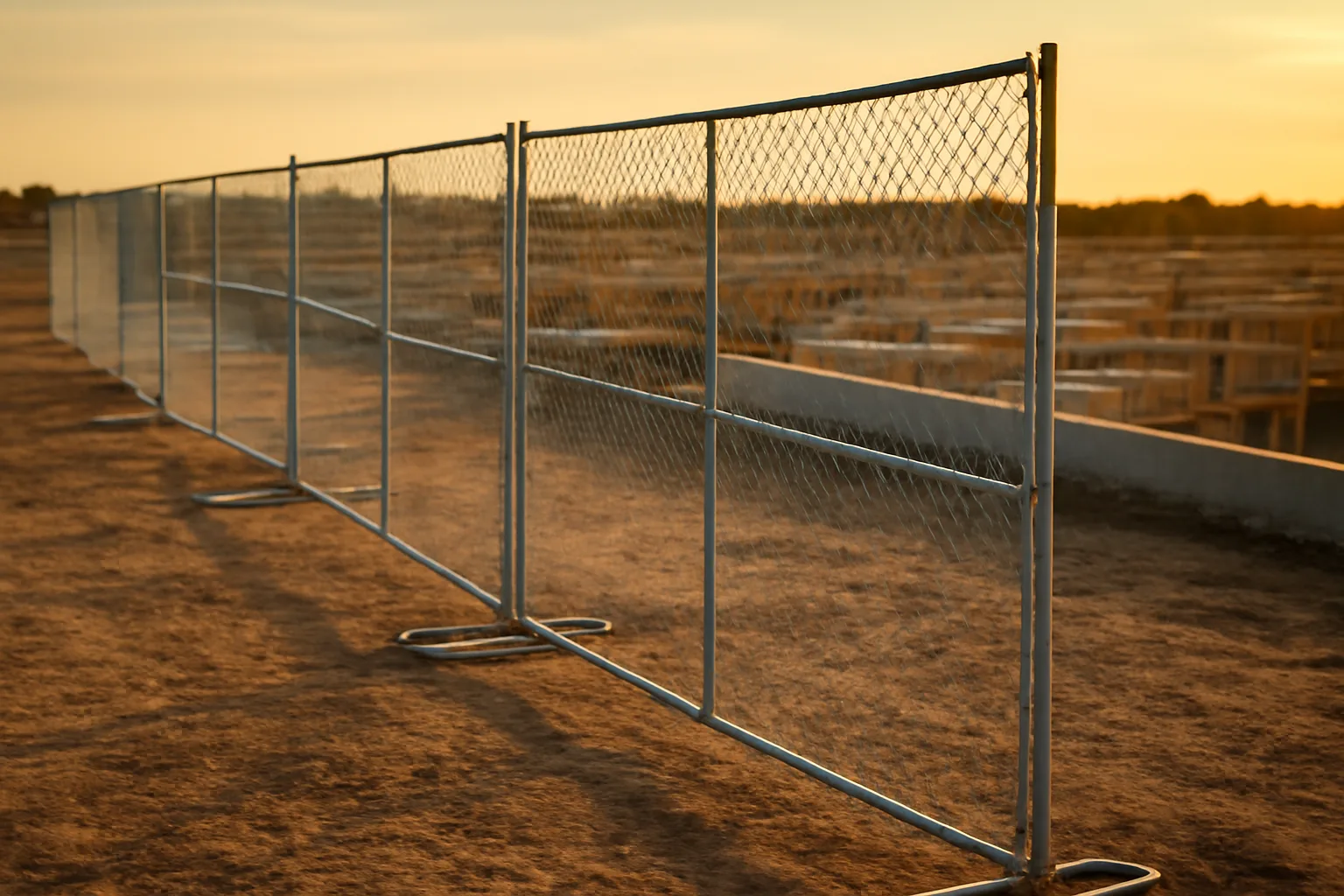
Standard chain-link panels in the Texas market run 6 feet tall and 10 feet wide, with 11-gauge or 11.5-gauge wire mesh. Heavier gauge holds its shape longer on high-use commercial sites but costs more up front. Most established operators stock at least 150 panels before their first commercial GC contract, and target 300 to 500 panels for a sustainable operation running multiple concurrent sites.
Base blocks matter more than new operators expect. Rubber-filled steel-base blocks are standard. Texas construction traffic is brutal on bases, so plan for 10 to 15 percent annual replacement of your base inventory from cracking, theft, or damage.
Wind is the variable most people underestimate. The Texas panhandle and West Texas are among the windiest regions in the country. A standing fence on a cleared site catches wind like a sail. Cable cross-bracing between panels, post-driven stakes at corners, and sandbag ballast all come into play depending on site conditions. Your bid document should carry a wind-bracing spec so the GC knows exactly what they're getting.
Want a paper kit that walks through the bid document structure for panel pricing, wind-bracing specs, and price-per-week math? TempFencePath's Panel + Wind + PW Bid Kit at /start covers it. One mention, because it's relevant here and genuinely useful for new operators.
A pickup truck or flatbed with a pallet fork is the minimum vehicle setup. A forklift-capable trailer cuts labor cost hard on large drops, but it's overkill until you're running 400-plus panels regularly.
What should you watch for when renewing with a Texas GC or project owner?
The permit renewal and the contract renewal are two different things, and confusing them is a common mistake.
Your municipal permit renews with the city. Your rental contract with the GC renews on whatever terms you both agreed to at the start. Those timelines often don't line up. When a project runs over schedule (routine in Texas commercial construction), you end up renewing your permit mid-contract or extending your rental agreement while the permit is still active.
Get a contract extension in writing before the original term expires. Verbal extensions are legally risky in Texas. The Texas Business and Commerce Code governs commercial contracts, and while oral agreements can be enforceable under some circumstances, equipment rental agreements with duration provisions are far cleaner in writing [10].
Watch for scope changes on the GC side too. If the project expands and the fence footprint has to grow, that's a new permit in most Texas cities, not a renewal. Walk the site before you submit any renewal paperwork and confirm the installed fence matches what the city has on file.
One more. Confirm your insurance certificate names the GC as additional insured on each project. That's nearly universal in Texas commercial construction. If your certificate lapses or the additional insured endorsement goes missing, you can get pulled off site regardless of your permit status.
Where can you find the official Texas licensing and permit sources?
Bookmark these directly. Agency homepages shift around, but the pages below are the most stable entry points for the information that matters.
Texas Department of Licensing and Regulation (TDLR) handles most licensed trades. Their license type list lets you search by trade to confirm whether any license applies to your specific scope [1].
Texas Secretary of State handles entity registration. Their business services portal walks you through LLC formation, registered agent requirements, and name availability, with the fee schedule published directly [4].
Texas Comptroller handles sales and use tax permits. The application and guidance on taxable services lives on their sales tax pages [8].
For city permits, the direct portals that matter are each city's building and development services site. Austin, Houston, Dallas, and San Antonio all let you apply, track, and renew permits online through their development services departments.
The Texas Department of Insurance publishes the workers' compensation coverage options and non-subscriber rules that decide your insurance exposure [6].
If you're also sizing up how other southern states structure this, temp fence renewal in Georgia and temp fence renewal in Alabama make useful comparisons.
Frequently asked questions
Do you need a license for temp fence in Texas?
Texas has no statewide temp fence contractor license. The Texas Department of Licensing and Regulation does not list temporary fencing as a licensed trade. What you may need depends on your city: Houston, Dallas, Austin, and San Antonio all have contractor registration or permit requirements for commercial site work. If your scope includes any permanent construction elements, general contractor rules may apply. Confirm with the relevant municipal board before operating.
How much does temp fence cost in Texas?
Panel rental in Texas runs roughly $3 to $8 per panel per month for standard 6x10 chain-link panels, depending on quantity and location. Delivery and installation adds $1.50 to $3.00 per linear foot. Wind bracing typically adds $0.50 to $1.50 per panel per month. Privacy screening is $1 to $2 per linear foot per month. City permits add a few hundred dollars depending on the jurisdiction. Get at least three quotes from regional suppliers.
How long does temp fence take in Texas?
Equipment delivery in Texas metro markets is typically 24 to 72 hours for standard stock orders. Permit processing takes 5 to 15 business days at most Texas city building departments, though the relevant board sets actual timelines and they fluctuate with application volume. Apply for the permit before ordering equipment so both clocks run in parallel. Renewals with no scope changes usually process in 3 to 7 business days.
Does Texas require a surety bond for temp fence contractors?
Texas does not require a statewide surety bond for temp fence operators. Individual cities may require a bond as part of a right-of-way or construction fence permit, particularly when the fence encroaches on a public sidewalk or street. GCs and project owners may also require a performance bond contractually. Confirm bond requirements with each city's building department and with the GC's contract terms before signing.
Is temp fence rental taxable in Texas?
The taxability of temp fence rental in Texas depends on how the transaction is structured. Equipment rental is generally subject to Texas sales and use tax, though specific treatment can vary. The Texas Comptroller's office is the authoritative source. Most temp fence operators in Texas register for a sales and use tax permit and collect tax on rentals, but consult a Texas CPA familiar with construction industry taxation to confirm your specific situation.
How do you renew a construction fence permit in Austin, Texas?
Austin's Development Services Department handles construction fence permit renewals through its online permit portal. You'll need a current certificate of insurance, confirmation that the fence footprint hasn't changed, and payment of the renewal fee. The city may schedule an inspection as part of the renewal review. Processing time fluctuates with application volume. Start the renewal process at least two weeks before the permit expiration date to avoid a lapse.
What insurance does a Texas temp fence company need?
General liability coverage of at least $1 million per occurrence and $2 million aggregate is standard. Texas allows employers to opt out of workers' compensation, but non-subscribers face unlimited tort liability for worker injuries. Most GCs require proof of workers' comp or an occupational accident policy before allowing subs on site. Inland marine coverage protects your panel fleet. GC contracts typically require you to name them as additional insured.
Do Texas cities require a permit for temp fence on private property?
Generally, temp fence entirely within private property and not affecting a public right-of-way does not require a city permit in most Texas jurisdictions. The permit requirement kicks in when fence touches or encroaches on a sidewalk, street, or other public right-of-way. Some cities also have height triggers. The rule varies by city, so confirm with the relevant municipal building department for each project location before assuming no permit is needed.
How many panels do you need to start a temp fence business in Texas?
Most operators take on their first commercial GC contract with 150 panels as a working minimum. A sustainable multi-site Texas operation typically targets 300 to 500 panels. The Texas construction market is large and competitive, so undersized fleets lose bids to suppliers who can deliver at scale. Start with enough inventory to cover one full job site completely, then grow from revenue rather than debt where possible.
What happens if your temp fence permit lapses in Texas?
A lapsed permit can trigger a stop-work order on the construction site, which creates a serious problem with your GC customer regardless of whose fault the lapse is. City inspectors in Houston, Austin, and Dallas actively check fence permits on commercial sites. You'd need to reapply, pay new permit fees, and potentially wait through a new review cycle before the fence is considered authorized again. Track expiration dates and renew at least two weeks early.
How does Texas temp fence licensing compare to California?
California requires a C-13 Fencing Contractor license from the Contractors State License Board to legally operate a temp fence business. Texas has no equivalent state license. In California, operating without the license is a criminal misdemeanor. In Texas, the risk is more at the city permit level than the state level. This makes Texas operationally simpler at startup but requires more city-by-city research since there's no single state framework to follow.
Can you operate temp fence in multiple Texas cities under one permit?
No. Permits are issued per project and per jurisdiction in Texas. A permit from Austin covers only that Austin project site. If you're running jobs in Dallas and Houston simultaneously, each site needs its own permit from the respective city. This is standard across all Texas municipalities. Budget for permit fees on every job site individually, and track each permit's expiration date separately.
What is the LLC formation cost for a Texas temp fence company?
The Texas Secretary of State charges a $300 filing fee to form an LLC as of 2024. You'll also need to appoint a registered agent with a Texas address, which costs $50 to $150 per year if you use a commercial service. A DBA filing at the county level runs $15 to $25 if you operate under a trade name. Total startup paperwork cost for a basic Texas LLC is typically $400 to $550 before attorney fees.
Do you need wind bracing for temp fence in Texas?
In practice, yes, especially in North Texas, West Texas, and Gulf Coast areas. Texas has several of the windiest corridors in the country, and an unbraced panel fence on a cleared construction site can fail in a significant wind event. Most Texas GC contracts and city permits require fencing to be properly braced. Cable cross-bracing and post-driven stakes at corners are standard. Include wind-bracing specs in your bid documents so expectations are clear before the job starts.
Sources
- Texas Department of Licensing and Regulation, License Types List: Texas TDLR oversees licensed trades in Texas; no temporary fencing contractor license exists at the state level
- Texas Occupations Code, Chapter 1305 (Electricians): Texas Occupations Code Chapter 1305 governs electrical contractor licensing as an example of state-level trade licensing
- Texas Secretary of State, Business Organizations Filing Fees: Texas LLC formation filing fee is $300, paid to the Texas Secretary of State
- Texas Department of Insurance, Workers' Compensation Coverage for Texas Employers: Texas allows private-sector employers to opt out of workers' comp (non-subscribers), who then face unlimited tort liability for worker injuries
- U.S. Census Bureau, Building Permits Survey 2023: Texas consistently ranks among the top states by annual building permit volume
- Texas Comptroller of Public Accounts, Sales and Use Tax for Equipment Rental: Equipment rental is generally subject to Texas sales and use tax; temp fence operators should register for a sales and use tax permit
- IRS, Employer Identification Numbers: A federal EIN is required for entities other than sole proprietors operating under their own name, and for any employer with W-2 employees
- Texas Business and Commerce Code, Chapter 26 (Statute of Frauds for Commercial Agreements): Commercial equipment rental contracts with duration provisions are more enforceable in writing under Texas law