Last updated 2026-08-18
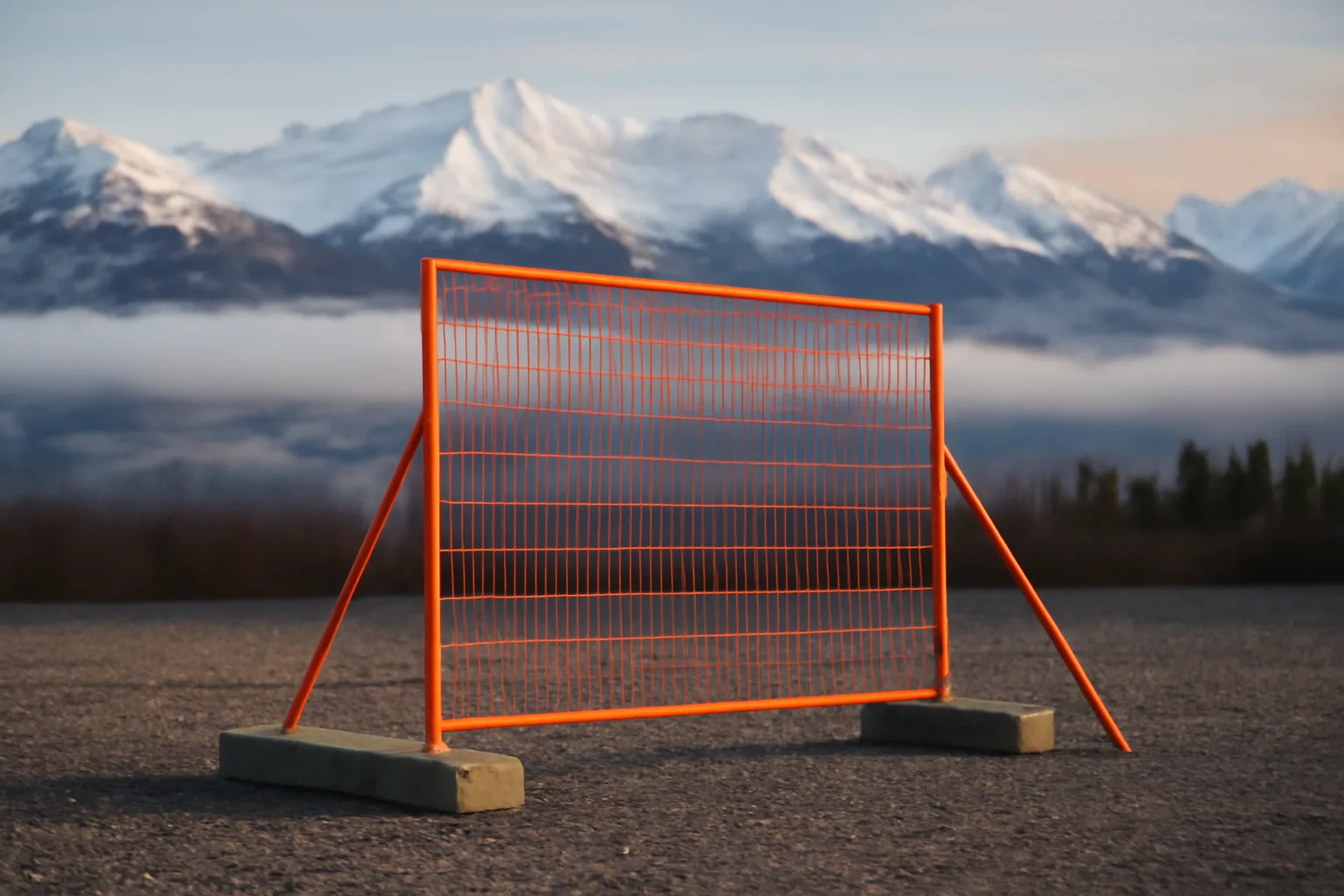
TL;DR
A standard 6x10 temp fence panel in Alaska rents for $30 to $70 per month, and buying runs $60 to $120 each. Delivery, wind bracing, and ballast push the final bill higher. A contractor license is required for any job of $10,000 or more, and licensing takes 2 to 4 weeks. Install runs 1 to 3 days when permafrost stays out of the way.
How much does temp fence cost in Alaska?
A 6-foot by 10-foot galvanized steel temp fence panel rents for $30 to $70 per month in Alaska. Where you land in that range depends on your distance from Anchorage and whether the site needs wind braces, concrete blocks, or heavy-duty feet. That's roughly $5 to $20 above the national midpoint [3].
Buying the same panel outright costs $60 to $120 each from a local supplier. The wide spread comes from shipping. A container off the Port of Seattle adds about $3 to $5 per panel when the cost splits across a full load. Order only ten panels and the freight eats you alive.
A 500-linear-foot construction site fence (about 50 panels) rents for $1,500 to $3,500 per month before extras. Run that six months and you're looking at $9,000 to $21,000. Buying 50 panels costs $3,000 to $6,000 upfront, and you still need bases, braces, and transport. Use the fence more than twice and buying usually wins.
What goes into temp fence pricing in Alaska?
Transportation is the biggest wildcard. Everything heavier than a postcard gets barged, trucked, or flown. A flatbed from Anchorage to Fairbanks adds $800 to $1,200 for a full load of fencing. Remote sites like Prudhoe Bay or Nome can double the material cost just to move gear there.
Wind bracing pushes the hardware bill up fast. Alaska's coastal and mountain zones sit in FEMA wind design zones where basic temp fence needs extra anchoring [6]. A panel clamped to one concrete block won't survive Wasilla when the katabatic winds pour down the Matanuska Valley. Add $8 to $15 per panel for wind braces and $20 to $35 per panel for precast concrete blocks heavy enough to hold.
Season swings the rate too. Peak construction runs May to September, and you'll pay the high end. In October and April, some yards cut prices 15% just to keep equipment moving. Schedule installs in the shoulder months if your project allows it.
Do you need a license for temp fence in Alaska?
Yes, if the job is $10,000 or more. Alaska Statute AS 08.18.011 requires a contractor license for anyone who takes on work "as a contractor" at that project cost or above [1]. Installing temporary fence counts as specialty contracting. The Alaska Division of Corporations, Business and Professional Licensing lists a "Specialty Contractor, Fencing" classification under its contractor program [2].
If your total invoice (materials, labor, and profit) crosses $10,000, you need that license before you pound the first post. Jobs under $10,000 don't require a state contractor license, but many boroughs and cities still want a local business license. Check with the local government every time.
Getting licensed takes time. The application needs a bond, proof of insurance, and a test or approval for the classification. Budget 2 to 4 weeks for processing once your paperwork is clean. There's no fast lane.
How long does temp fence take in Alaska?
A straightforward install on compacted gravel or asphalt takes one to three days for a crew of two, assuming the panels, bases, and braces are already staged on site. Frozen ground with permafrost costs you days. Digging post holes in permafrost isn't practical, so you switch to surface-mounted ballast bases, which set faster but add real weight and cost [5].
Weather delays are the norm. High winds, snow, and rain shut down work for safety. In Anchorage, average wind speed sits near 9 mph year-round, but winter gusts over 30 mph are common [4]. You can't stand up panels safely when the wind is knocking them flat. Build a two-day weather buffer into any project between October and April.
Mobilization eats a day or two on its own. Hauling 50 panels and 100 concrete blocks from a rental yard to the site and back is non-negotiable. If the site sits 100 miles from the nearest yard, the round trip can add $600 in fuel and driver time.
Why does Alaska site prep matter for permafrost and gravel?
In most of the Lower 48, you drive T-posts and call it done. Not here. Permafrost under a gravel pad acts like a natural refrigerator that heaves and shifts with the seasons. University of Alaska Fairbanks Cooperative Extension warns that building on permafrost demands close attention to thermal disturbance [5]. Even temporary fence footings can trigger thaw if they pierce the insulating vegetation layer.
So you either use surface-mounted concrete ballast blocks (expensive and heavy) or you run a pre-install geotechnical check to confirm the ground won't heave. Most contractors go with ballast. Count on 150 to 200 pounds of ballast per panel in high-wind areas. For a 50-panel job, that's 7,500 to 10,000 pounds of concrete you have to move.
Site access matters too. Many Alaska sites use thick gravel pads that are fine for driving a skid steer but a headache when you need to level blocks. Leveling uneven ground adds a half day of labor on a typical perimeter fence.
How do wind and weather anchoring requirements drive cost?
FEMA wind zone maps put much of coastal and interior Alaska into zones where basic temp fence panels have to resist 90 mph gusts or more [6]. A standard panel weighs about 40 pounds. At 90 mph, the lateral force on that panel can top 300 pounds. Wind braces and heavy ballast aren't optional. They're a safety requirement.
Plan on at least one brace per four panels in exposed sites. Each brace adds $8 to $15 to the monthly rental or $30 to $50 to the purchase price. Concrete ballast blocks rent for $4 to $6 each per month, and you need two per panel as a baseline. That's an extra $400 per month on a 50-panel site.
Don't skimp. An unbraced panel that blows into traffic is a liability nightmare. Ask your supplier for a wind load calculation. If they can't produce one, walk.
Renting vs. buying: which saves money in Alaska?
For a single project running six months or less, renting almost always wins, even at Alaska's higher rates. The rental shop handles delivery, pickup, and replacement of damaged panels. A 50-panel site over six months rents for $9,000 to $21,000. Buying the same 50 panels plus ballast and braces costs $5,000 to $10,000 upfront, but then the gear is yours.
Break-even lands around the second or third deployment. If you'll use the fence on multiple projects or run a business that needs fence again and again, buying pays off after 12 to 18 months of steady use. Storing panels through an Alaska winter takes heated or covered space. Freeze-thaw cycles chew up cheap galvanizing. Plan to replace about 10% of your panels after two winters.
There's a third path: rent-to-own. Some Anchorage suppliers apply a slice of your rental payments toward purchase. Worth a look if you're not sure your project runs long enough to justify buying outright.
How does temp fence cost in Alaska compare to other states?
Alaska is in a class of its own on price. Shipping alone adds 20% to 40% over what you'd pay in the Pacific Northwest. In Texas, rental rates hover around $20 to $40 per panel per month. In California, figure $25 to $50. Even hurricane-prone Florida, with its own wind bracing rules, stays under $35 to $55.
Pricing a multi-state operation? Grab our guides for Arizona and Alabama too. The cost drivers shift by region: wind in Alaska, hurricanes in the Gulf, desert heat that cracks plastic feet in Phoenix. Knowing the local baseline keeps you from bleeding margin when you bid a job somewhere new.
How much does a temp fence license cost in Alaska?
The license itself isn't the big line. The state application fee for a specialty contractor runs about $250, and you'll also need a surety bond. Bond amounts for specialty contractors start at $10,000 in Alaska. The premium on a $10,000 bond averages $100 to $300 per year, depending on your credit. General liability insurance adds $500 to $2,000 annually for a small fencing operation [2].
Add it up and you're looking at roughly $850 to $2,550 in upfront licensing costs before you hang your first panel. That's a one-time barrier. Doing one small job under $10,000? Skip the license and get local business registration instead. Planning to make temp fence a business? The license opens the door to bigger projects.
Getting an accurate quote: what to ask suppliers
Don't take a ballpark over the phone. Hand the supplier a site plan with linear footage, gate locations, and a wind exposure note. Ask for a line-item quote that splits panel rental, ballast rental, delivery, pickup, and damage waiver. Many Alaska yards tack on a winter surcharge for delivery to cover frozen road conditions.
A bid kit helps you gather these details. TempFencePath sells a $149 one-time bid kit with wind load calculations, a spec sheet template, and a price comparison tool. It won't replace a professional estimate, but it gives you a consistent way to line up three or four supplier quotes without missing hidden costs.
Read the supplier's rental agreement and damage policy before you sign. Some shops bill lost panels at full retail replacement cost. That turns a $500 monthly rental into a $3,000 surprise when a loader backs into your fence line.
5 tips to keep temp fence costs under $2,000 in Alaska
Order early. Reserve panels at least six weeks before peak season to lock in shoulder-month rates even if the fence goes up in June. Many yards honor early booking prices.
Avoid custom gate hardware. Standard 6-foot walk gates and 12-foot drive gates share components with standard panels. Custom 20-foot slide gates need fabricated steel and take weeks, often doubling the gate cost.
Pick up the fence yourself if the site is within 30 miles of the yard and you have a flatbed. Delivery fees drop $200 to $400 per round trip just by cutting driver time.
Use a modular system so you can reuse base blocks and braces. Don't pour concrete sonotubes for a temporary fence. Surface ballast is cheaper long-term because you take it with you.
Bundle your project with other crews. If an excavation or roofing outfit is mobilizing to the same remote site, split the freight. One shared load can cut your transport cost in half.
What insurance and bonding do I need in Alaska?
Contractor licensing in Alaska requires general liability insurance and a surety bond for jobs over $10,000. Even under that threshold, most project owners and general contractors want proof of insurance before they let you on site. A standard $1 million general liability policy costs a small fencing contractor $600 to $1,500 per year [2].
Wind damage claims are the most common. If an unbraced panel flies into a vehicle, your insurance is on the hook. Bonding protects the client if you disappear mid-project. For a small specialty contractor, a $10,000 surety bond premium runs $100 to $300 a year. Cheap peace of mind.
Quick start: temp fence in Alaska step by step
1. Measure the site and calculate linear feet. Add 10% for cut panels and gates. 2. Check the ground: thawed gravel or frozen permafrost? Frozen means ballast only. 3. Pull wind zone data from FEMA or your local building official to set bracing requirements [6]. 4. Request three line-item quotes from local rental yards or suppliers. 5. If the total job cost tops $10,000, verify your contractor license is active [1][2]. 6. Order materials and schedule delivery at least two weeks ahead. Add weather buffer days. 7. Install panels, braces, and ballast. Inspect wind security before you leave the site each day. 8. After the job, arrange pickup. Document any damage immediately to head off disputes.
Serious about running this as a business? TempFencePath's $149 bid kit includes panel, wind, and prevailing wage templates that speed up the first seven steps.
Frequently asked questions
Do you need a license for temp fence in Alaska?
Yes, for any project where the total contract price, including materials and labor, is $10,000 or more. Alaska Statute AS 08.18.011 requires a state contractor license, and the classification is "Specialty Contractor, Fencing." Jobs under $10,000 don't need a state license, but a local business license may still be required.
How much does temp fence cost in Alaska?
Rental runs $30 to $70 per panel per month. Buying costs $60 to $120 per panel. These figures include the transportation premium and wind bracing needs typical in Alaska. For a 500-linear-foot site, expect $1,500 to $3,500 per month to rent, or $3,000 to $6,000 to buy. Exact numbers depend on distance from Anchorage and the install season.
How long does temp fence take in Alaska?
A standard install takes one to three days for a two-person crew once materials are on site. If permafrost forces a ballast-only setup, add a day for leveling. Weather delays are common from October through April. Build two extra days into your schedule for wind or snow.
Can I install temp fence on permafrost?
Yes, but not with driven posts. Permafrost stops digging, so you must use surface-mounted ballast blocks. UAF Cooperative Extension warns that puncturing the active layer can cause thaw and ground instability [5]. Use concrete blocks weighing 150 to 200 pounds per panel in high-wind zones.
What is the cheapest temp fence option in Alaska?
Renting standard galvanized panels in the off-season (October or April) and picking them up yourself is the lowest cost. Skip wind braces unless the site requires them. For a small job, a local supplier near Anchorage may offer discounted older panels. The cheapest purchase option is used panels from a rental yard's inventory clearance.
Does temp fence require a building permit in Alaska?
Temporary fencing for construction sites usually doesn't require a building permit. Some municipalities, like Anchorage, may require a right-of-way permit if the fence crosses a sidewalk. Check local ordinances. Permanent fencing is a different animal and usually needs a zoning permit.
How much does wind bracing add to temp fence cost?
Wind braces add $8 to $15 per panel per month to rental, and $20 to $35 per panel for concrete ballast blocks. On a 50-panel site, that's about $400 extra per month. In FEMA wind zones with 90 mph gusts, bracing is required for safety and insurance compliance [4][6].
How do I get a contractor license in Alaska for fencing?
Apply through the Alaska Division of Corporations, Business and Professional Licensing. You need a completed application, a surety bond (minimum $10,000 for specialty contractor), proof of general liability insurance, and a passing exam score for the fencing classification. Processing takes 2 to 4 weeks [2].
Can I rent or buy temp fence panels directly in Fairbanks?
Yes, but inventory is thinner than in Anchorage. A few equipment rental yards in Fairbanks stock panels, often at higher rates because of trucking them from the port. Expect the top end of the rental range ($60 to $70 per panel) and confirm availability ahead of time.
What insurance do I need for a temp fence business in Alaska?
General liability insurance is a near-universal requirement. A $1 million policy costs about $600 to $1,500 per year for a small operation. If you take jobs over $10,000, Alaska law requires a $10,000 surety bond, which costs $100 to $300 annually. Workers' compensation is also mandatory if you have employees.
Is it better to rent or buy temp fence for one summer in Alaska?
For a one-summer project, rent. The rental cost for 3 to 4 months ($4,500 to $14,000 for a 50-panel site) is less than buying ($5,000 to $10,000) plus storage and winter damage. Unless you have a heated warehouse and plan to reuse the panels, renting avoids off-season headaches.
Sources
- Alaska Legislature, AS 08.18.011: Contractor license required for projects worth $10,000 or more.
- Alaska Division of Corporations, Business and Professional Licensing, Contractor Section: Specialty Contractor, Fencing classification, bond and insurance requirements.
- HomeAdvisor, Temporary Fence Installation Cost Guide: National average rental cost of $25, $50 per panel per month, purchase $30, $80 per panel.
- NOAA National Weather Service, Anchorage: Average wind speed near 9 mph, frequent winter gusts over 30 mph.
- University of Alaska Fairbanks Cooperative Extension, Building in Alaska: Permafrost: Permafrost construction requires thermal protection; surface ballast preferred for temporary structures.
- FEMA, Wind Zones and Building Science: Coastal and interior Alaska are in high-wind design zones requiring bracing.