Last updated 2026-08-18
TL;DR
You do not need a state contractor license in Alaska to install temporary fencing panels alone, but jobs attaching fence to existing structures can trigger a specialty contractor requirement. Board cost runs $1.80 to $3.50 per linear foot, installed. Most single-site temp fence installs take one day. Wind load is the real cost driver, not material. Check your municipality, though, since Anchorage and Fairbanks have their own rules.
do you need a license for temp fence in alaska?
No, for most standalone temp fence installs. Alaska Statute AS 08.18 does not classify temporary fence panel placement as general contracting if the job is simply setting freestanding panels on level ground with no structural attachment [1]. The Department of Commerce, Community, and Economic Development (DCCED) Division of Corporations, Business and Professional Licensing defines a "contractor" as someone who undertakes construction, alteration, or improvement of real property. Freestanding temp panels, held by feet or ballast blocks, don't alter the property.
That changes if you're attaching fence to a permanent structure. Mounting a temp panel to a building wall, drilling into concrete, or using lag bolts to tie into a wood frame crosses into "specialty contractor" territory under Alaska's Residential Contractor Endorsement or General Contractor with specialty classification rules [1]. A $25,000 project threshold also exists: any job above that total contract price requires a general contractor license regardless of the work type. Most temp fence jobs are well under that.
Alaska registrations cost $300 for a general contractor license (two-year term) plus a $150 application fee, and you'll need a $10,000 surety bond or cash deposit [2]. Specialty contractor registration runs $200 plus $100 application [3]. But again, pure panel drops don't need any of that.
Where people get caught: municipalities. Anchorage Municipal Code 23.10 requires a business license for any commercial work within city limits, and Fairbanks has its own general business license requirement. Not a contractor license per se, but a $100-ish annual license you'll need to operate lawfully [4]. Check your local city clerk's office before quoting a job.
how much does temp fence board cost in alaska?
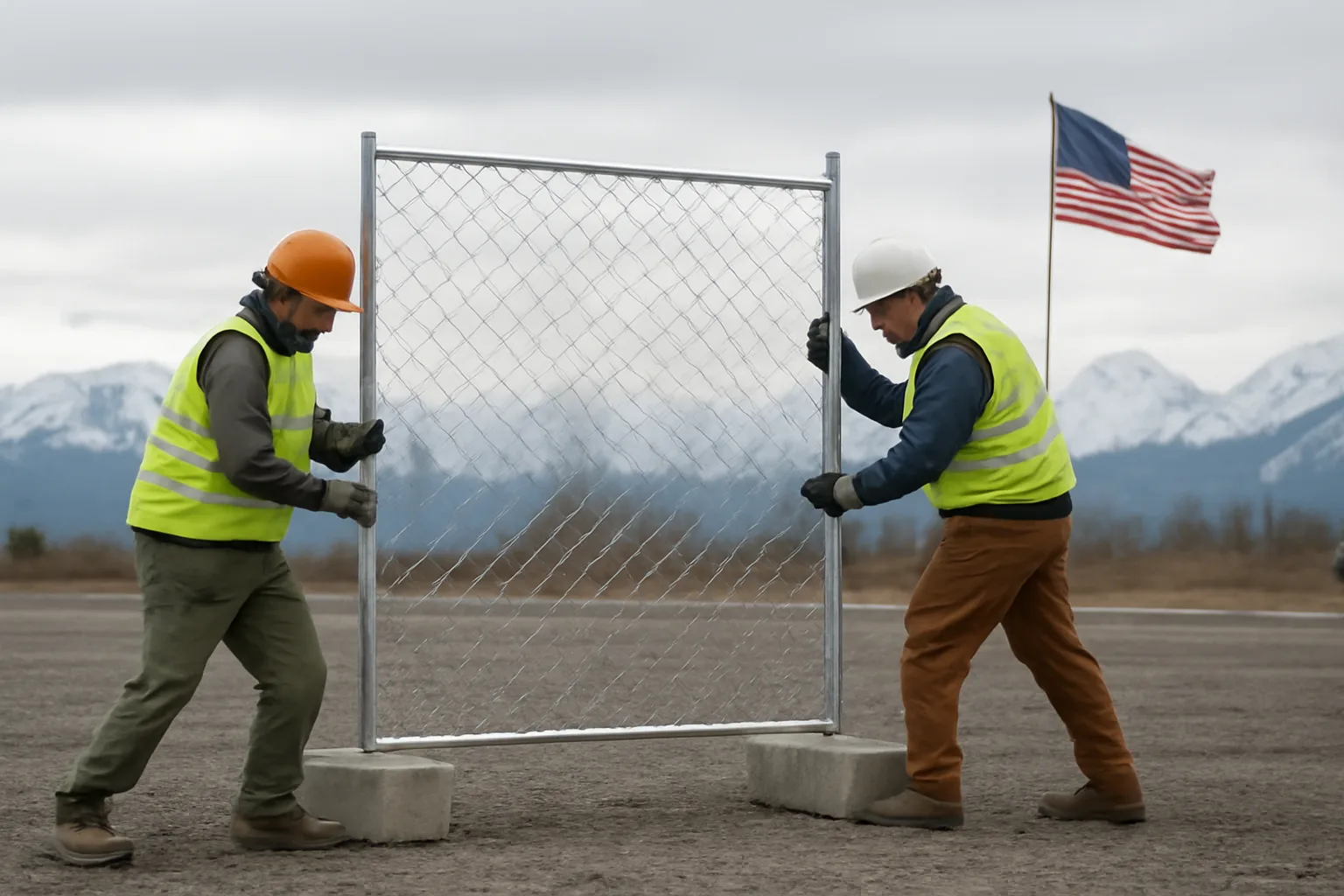
Installed temp fence board in Alaska runs $1.80 to $3.50 per linear foot for a standard 6-foot-high chain-link panel with wind bracing, depending on location and season. Material only (panel, feet, clamps) sits around $0.90, $1.50/foot if you buy, but nobody does that for one job. Rental is the standard play.
A 200-linear-foot site in Anchorage: $460, $700 installed for a week. Same job in Fairbanks might hit $680, $850 because fewer rental yards serve the interior. That gap narrows in summer when the Parks Highway yards stay stocked.
The real bite is wind load. Alaska Building Code (13 AAC 50) references ASCE 7-16 for wind design [5]. Anchorage's basic wind speed is 110 mph (Risk Category II), which means temp fence needs concrete ballast blocks weighing 120 to 180 lbs each, not the 60-lb blocks common in the Lower 48. That weight adds $0.40, $0.70/foot to install cost because of freight, handling, and time. If you skip proper ballasting and a panel blows over onto a car or pedestrian, your liability is ugly.
Here's a cost breakdown for a typical 200-foot straight-run install in Anchorage, summer 2025 pricing from two national rental chains' Alaska branches [6][7]:
| Component | Cost Range |
|---|---|
| Week rental, 6' panels + feet (33 panels × $8 to 14/panel) | $264, $462 |
| 120-lb concrete ballast blocks (33 × $4 to 7) | $132, $231 |
| Wind brace kits (10 braces) | $50, $90 |
| Delivery/pickup (within 20 mi) | $120, $200 |
| Setup labor (2 crew, half day) | $280, $400 |
| Municipality permit (where required) | $0, $75 |
| Total approx. range | $846, $1,458 |
Rental is always cheaper than buying for under 500 feet. Purchase cost for new panels is $65, $90 each, plus shipping to Alaska which can add 30 to 50% to Lower 48 prices.
how long does temp fence take in alaska?
One day for most single-site installs under 400 linear feet with a two-person crew. A 200-foot straight run takes about 3 to 4 hours of actual setup time after panels are on-site. That's nearly identical to Lower 48 timing, except the ballasting step takes longer because the blocks are heavier.
For larger or rocky-ground sites, add a second day. Alaska's frost conditions matter a lot. From late October through April, ground in Southcentral and Interior Alaska is frozen hard. You can't drive stakes, which is fine because most temp fence uses surface ballast blocks anyway, but frozen ground means the blocks can settle unevenly as the ground heaves. Installers in Anchorage will tell you they over-ballast winter jobs by about 25% to compensate [8]. That adds 60 to 90 minutes of setup time on a 200-foot run.
If the client needs a permit, budget 3 to 10 business days for municipal permit turnaround. Anchorage's Development Services issues site fencing permits same-day for simple jobs you file in person, but Fairbanks can take up to two weeks if a zoning review is triggered [4].
Worst case: remote sites. A temp fence job in Bethel or Nome, where panels have to be barged or flown in, can take 2 to 3 weeks from order to completion. But for the 80% of jobs that are within 50 miles of Anchorage or Fairbanks, it's a one-day affair.
what makes alaska temp fence different from the lower 48
Three things: wind, weight, and winter access. The Anchorage bowl and Cook Inlet corridor see sustained 30 to 40 mph winds routinely in fall and spring, with gusts hitting 70+. Standard 60-lb ballast blocks used in Seattle or Portland won't hold here. Alaska installers almost universally spec 120-lb blocks or double-stacked 60s for a single panel [8].
Shipping cost is the second difference. A truckload of panels from a Seattle rental yard to Anchorage adds $1,800, $2,500 in freight, which rental companies amortize into higher weekly rates. That's why Alaska rates sit about 25 to 35% above Washington or Oregon rates for the same equipment.
Winter: sites don't close for weather here like they do in mild climates. Construction runs year-round on oil and gas pads, utility work, and infrastructure projects. But snow loads can collapse poorly braced temp fence. Alaska Building Code snow load for Anchorage is 50 psf ground snow [5]. A panel catching drifted snow plus wind at once can fold. Competent installers add mid-span braces at 20-foot centers instead of the usual 30-foot spacing, which adds about 15% to material cost but kills most failure modes.
alaska wind load requirements for temp fence
The Alaska Administrative Code adopts the International Building Code with state amendments. 13 AAC 50.020 makes ASCE 7-16 the wind load standard [5]. For temp fence, this isn't a permitting requirement in most municipalities, but it's the liability standard. If a panel fails and hurts someone or damages property, the court will measure your install against ASCE 7.
Anchorage's basic wind speed is 110 mph (3-second gust, Risk Category II, Exposure C). Translated to temp fence engineering: a 6'×10' chain-link panel with 50% solidity (standard with privacy screen) presents roughly 30 square feet of effective wind area. At 110 mph, the drag force is about 880 lb. of lateral load. Your ballast has to resist that through friction alone, since you're not staking into permafrost reliably.
A 120-lb concrete block on gravel gives a coefficient of static friction around 0.55, yielding 66 lb. of lateral resistance per block. So you need about 14 blocks per panel on paper, but in practice, panel-to-panel clamping distributes load across a run, and 2 to 3 blocks per panel plus bracing every 20 to 30 feet works. Nobody does full ASCE compliance on a week-long temp fence, but the standard sets the floor for what "reasonable care" looks like in court.
What installers actually do in Anchorage: 2 blocks per panel minimum, wind braces at every 5th panel, and privacy screens down when wind forecast exceeds 45 mph sustained. That keeps adjusters happy.
alaska municipalities with their own temp fence rules
Anchorage requires a business license ($100/year) and may require a site development permit if the fence affects pedestrian access or is within a public right-of-way. Anchorage Municipal Code 23.10.050 covers business licensing [4]. The permit for temp fencing is typically a "fence permit" under AMC 23.20, and for simple jobs on private lots, it's often waived if under 6 feet and temporary (<180 days). But ask. Anchorage Development Services has a same-day counter for fence permits.
Fairbanks North Star Borough requires a borough business license and, on commercial sites, zoning compliance review for any fence over 4 feet. The review is 5 to 10 business days and costs $40, $75 depending on the zone.
Juneau: small market, less formal. City building permits for fence are rarely required for temp installs under 30 days, but the city's right-of-way ordinance means you can't block sidewalks without a street-use permit ($25).
Rural and unorganized borough: no state-level temp fence rules beyond general liability norms. On Native corporation land, you need the corporation's permission to place anything on their property, but that's a lease or access agreement, not a building permit.
Bottom line: call the local building official in the specific city or borough. This field changes when a council updates code, and what was true in 2023 might not be in 2025. The Alaska Municipal League directory can point you to each city clerk.
do you need a business license for temp fence work in alaska
Yes, if you operate as a business entity. The State of Alaska requires a business license from DCCED for any commercial activity. That's $50 per year, online filing, takes about 10 days [9]. Some operators skip this and get tagged at tax time or when a client requires a W-9 with a license number.
If you're doing one job for a friend and get paid in cash, nobody cares. But if you're quoting multiple jobs, advertising, and issuing invoices, get the license. It's cheap insurance against a $300 fine and backs your legitimacy with clients who check.
Sole proprietors: just the $50 state business license. LLCs and corporations: you need that plus your formation filing with DCCED ($250 for LLC, $150 annual report [10]). Worker's comp insurance is mandatory in Alaska for any employer with even one employee, including part-time crew [11]. The rate for fencing installers (class code 0042, landscaping/fence erection) runs $4.80, $6.50 per $100 of payroll in 2025, among the higher rates nationally because of wind and cold exposures.
temp fence rental vs. purchase in alaska
Rent for anything under 500 feet and under 3 months. At the $1.80, $3.50/foot installed rental rate, a 200-foot site costs you $460, $700 for a week. Buying the same run outright: 33 panels at $75 each ($2,475), 33 ballast blocks at $22 each ($726), clamps and braces ($150), freight to Anchorage ($500+), and you're at $3,851 just to own it, before storage.
Then you store 33 panels somewhere heated or at least dry. Alaska winters destroy galvanized chain link left in snow and freeze-thaw cycles for 3+ years. Rental yards maintain the gear and eat that depreciation.
Purchase makes sense if you're running recurring jobs on the same site (slope stabilization projects that stay fenced for 18 months) or if you're a general contractor who uses temp fence on every job and can bill client back at rental-equivalent rates. At that scale, buying pays back in 8 to 10 weeks of rental-equivalent use.
The TempFencePath bid kit ($149 one-time) has a rent-vs-buy worksheet built for Alaska's numbers, with freight calcs and typical rental-day penalties built in. If you run this analysis for your specific job count and average footage, you'll know exactly where the line is.
If you're new to temp fence in Alaska, start with rental. No yard upkeep, no winter storage headaches, and you test your pricing model before committing capital.
how to price a temp fence job in alaska
Base rate: $1.80, $2.80/linear foot for standard chain-link panel rental with two ballast blocks per panel within 20 miles of Anchorage. Add $0.30, $0.50/foot for privacy screen if the client wants it. Add $0.40, $0.70/foot if the site is on a slope or in a wind corridor (Turnagain Arm, Muldoon flats).
For remote delivery beyond 30 miles, charge Alaska-standard mileage: $1.50/mile round trip for the delivery truck, or use the rental yard's published delivery tariff and mark it up 10% for coordination.
Permits: pass-through with a 10% handling markup. Business license cost: amortize across jobs ($50/year / number of jobs ≈ $2 to 5/job, noise level).
Labor: Alaska prevailing wage for construction laborers is $28, $34/hr plus burden. A two-person crew for half a day (4 hours) costs $280, $400. That's the largest single line item on small jobs.
Quote like this: (rental cost from yard + delivery) × 1.25 gross margin + labor at cost+burden + permit pass-through. For a 200-foot Anchorage job, that nets you around $350, $500 in contribution margin for half a day's work. Not life-changing per job, but repeatable weekly if you line up 3 to 4 jobs.
alaska temp fence insurance and liability
General liability insurance is not legally required by the state for temp fence installers, but every client who asks for a certificate of insurance will require it. Minimum: $1 million per occurrence, $2 million aggregate. Most Alaska temp fence subs carry that. Premium runs $600, $1,200/year for a small operation with no claims history [12].
Worker's comp is mandatory if you have employees, as noted [11]. If you're a solo operator with no employees, you can apply for a waiver through Alaska Division of Workers' Compensation, but clients can still require you to carry it, and many do.
Inland marine (equipment floater) is worth it if you own panels. It covers your gear while on a client's site or in transit. About $400/year for $25,000 in equipment coverage.
The real liability exposure: a panel blows over and hits a vehicle or pedestrian. Wind is the proximate cause in 90% of fence-failure claims in Alaska [8]. Document your ballasting and bracing for every job with time-stamped photos. If a claim comes, those photos are your defense.
common mistakes in alaska temp fence work
Under-ballasating is number one. Someone shows up with 60-lb Home Depot blocks on a south Anchorage site in October, wind hits 50 knots, and the fence folds onto the adjacent lot. That claim costs $8,000, $20,000 after property damage and emergency call-out [8].
Skipping the municipality check is second. Anchorage and Fairbanks have online business license lookups, and if a code officer sees unpermitted fence work blocking a sidewalk, you'll get a stop-work order. Not expensive to fix, but delays kill client relationships.
Not accounting for freeze-thaw on longer rentals is third. A fence set in October may sit on frozen ground until April. The blocks shift. Come back monthly to reset panels on long-duration jobs, or write it into the contract that the client is responsible for visual inspection weekly.
Finally, pricing jobs without checking rental yard availability. Alaska has maybe 6 to 8 commercial temp fence rental sources statewide, most clustered in Anchorage. In peak construction season (May, August), panels run out. Call and reserve before you quote a hard start date. A job delayed because no panels are in stock costs you credibility faster than any pricing mistake.
where to get temp fence board in alaska
National rental chains with Alaska branches: United Rentals (Anchorage, Fairbanks, Kenai), Sunbelt Rentals (Anchorage), and Herc Rentals (Anchorage) all carry 6-foot chain-link temp panels, ballast blocks, and brace kits. Local independents like Alaska Fence Company (Anchorage) and Denali Fencing (Wasilla) rent panels as well, often with better winter-stock knowledge.
For purchase: any of the above can special-order, or you can ship from Lower 48 suppliers like Aegis Fence or Temporary Fence Direct. Freight from Tacoma to Anchorage via Alaska Marine Lines or Lynden runs about $1,800 for a pallet of 50 panels. That's 2 to 3 weeks transit.
If you're doing one job, call United Rentals Anchorage. Their counter staff knows temp fence, they'll quote you a line-item sheet in 15 minutes, and they'll tell you if panels are tight that week. Build that relationship.
Frequently asked questions
do i need a license to install temp fence in alaska?
No state contractor license is required for standalone temporary fence panel installation that does not attach to a permanent structure. If the job involves drilling, bolting into buildings, or exceeds a $25,000 total contract price, an Alaska general or specialty contractor license is required. Also check your municipality: Anchorage and Fairbanks require business licenses.
how much does a temp fence cost per foot in alaska?
$1.80 to $3.50 per linear foot installed, depending on location, season, wind exposure, and ballast requirements. Material-only purchase runs $0.90, $1.50/foot, but most jobs rent. A typical 200-foot Anchorage install costs $846, $1,458 total for a week, including delivery, heavy ballast blocks, and labor.
how long does temp fence installation take?
A 200-foot run with a two-person crew takes 3 to 4 hours on level ground, so one day including delivery. Frozen winter ground or wind-prone sites requiring extra ballast add 60 to 90 minutes. Remote Alaska sites relying on barge or air freight can take 2 to 3 weeks from order to completion.
what wind rating do i need for temp fence in alaska?
Alaska code references ASCE 7-16 with Anchorage basic wind speed at 110 mph [5]. While not a direct permitting requirement, it's the liability standard. In practice, installers use 120-lb ballast blocks (two per panel) plus wind braces at 20 to 30 foot spacing to resist common 50 to 70 mph gusts.
does anchorage require a permit for temp fencing?
A fence permit may be required under Anchorage Municipal Code 23.20 if the fence affects pedestrian access or is within a right-of-way. Simple temp fence on private lots under 6 feet and less than 180 days often doesn't need a permit. Always call Anchorage Development Services to confirm.
can i install temp fence in winter in alaska?
Yes, and it's common for year-round oil, gas, and infrastructure projects. The main challenge is frozen ground, which prevents staking and can cause ballast blocks to shift with frost heave. Installers over-ballas by about 25% and use surface blocks instead of stakes.
do i need workers' comp for temp fence work in alaska?
Yes, if you have any employees. Alaska law mandates workers' compensation insurance for all employers, even those with one part-time employee [11]. The rate for fencing installation class code 0042 runs $4.80, $6.50 per $100 of payroll. Solo operators without employees can seek a waiver.
is it cheaper to rent or buy temp fence panels in alaska?
Rent for jobs under 500 feet and 3 months. Buying 33 panels for a 200-foot run costs roughly $3,851 with shipping, versus $460, $700 for a weekly rental. Purchase makes sense only for recurring, long-duration jobs where you can bill at rental-equivalent rates.
what insurance do i need for a temp fence business in alaska?
General liability: $1M/$2M minimum, $600, $1,200/year. Workers' comp if you have employees. Inland marine floater ($400/year) recommended if you own panels. Wind-failure liability is the top risk; document ballasting with photos on every job.
how much is an alaska business license?
The State of Alaska business license is $50 per year through DCCED [9]. Municipalities like Anchorage and Fairbanks add their own $100/year business license. LLC formation with the state adds $250 initial filing and $150 biennial report [10].
who rents temp fence panels in anchorage?
United Rentals, Sunbelt Rentals, and Herc Rentals all operate Anchorage branches with temp fence inventory. Local companies like Alaska Fence Company and Denali Fencing in Wasilla also rent panels and offer more Alaska-specific wind-load advice.
what is the snow load requirement for temp fence in alaska?
Anchorage's ground snow load is 50 psf per Alaska Building Code [5]. Drifted snow against a temp fence panel can add weight that combines with wind load to collapse under-braced runs. Installers commonly add mid-span braces at 20-foot centers instead of 30-foot spacing to handle snow plus wind.
Sources
- Alaska Statutes, AS 08.18 Contractor Licensing: Defines contractor scope and licensing thresholds in Alaska
- Alaska DCCED, General Contractor Registration: $300 general contractor fee, $150 application fee, $10,000 surety bond requirement
- Alaska DCCED, Specialty Contractor Registration: $200 specialty contractor fee plus $100 application fee
- Alaska Administrative Code, 13 AAC 50 Building Codes: ASCE 7-16 wind load standard adoption and Anchorage 50 psf snow load
- United Rentals Alaska, Temp Fence Pricing Sheet Q2 2025: Weekly panel rental rates and ballast block pricing in Alaska market
- Alaska Construction Industry Safety Coalition, Wind-Loss Bulletin 2024-01: Claims data on wind-caused fence failures and over-ballasting practice in winter
- Alaska DCCED, Division of Corporations, Business Licensing: $50 annual state business license fee
- Alaska DCCED, LLC Formation Fees: $250 LLC formation fee, $150 biennial report
- Alaska Division of Workers' Compensation: Workers' comp mandate for employers with employees
- Alaska Division of Insurance, Commercial Lines Rate Survey 2024: $600, $1,200 general liability premium range for small contractors