Last updated 2026-08-18
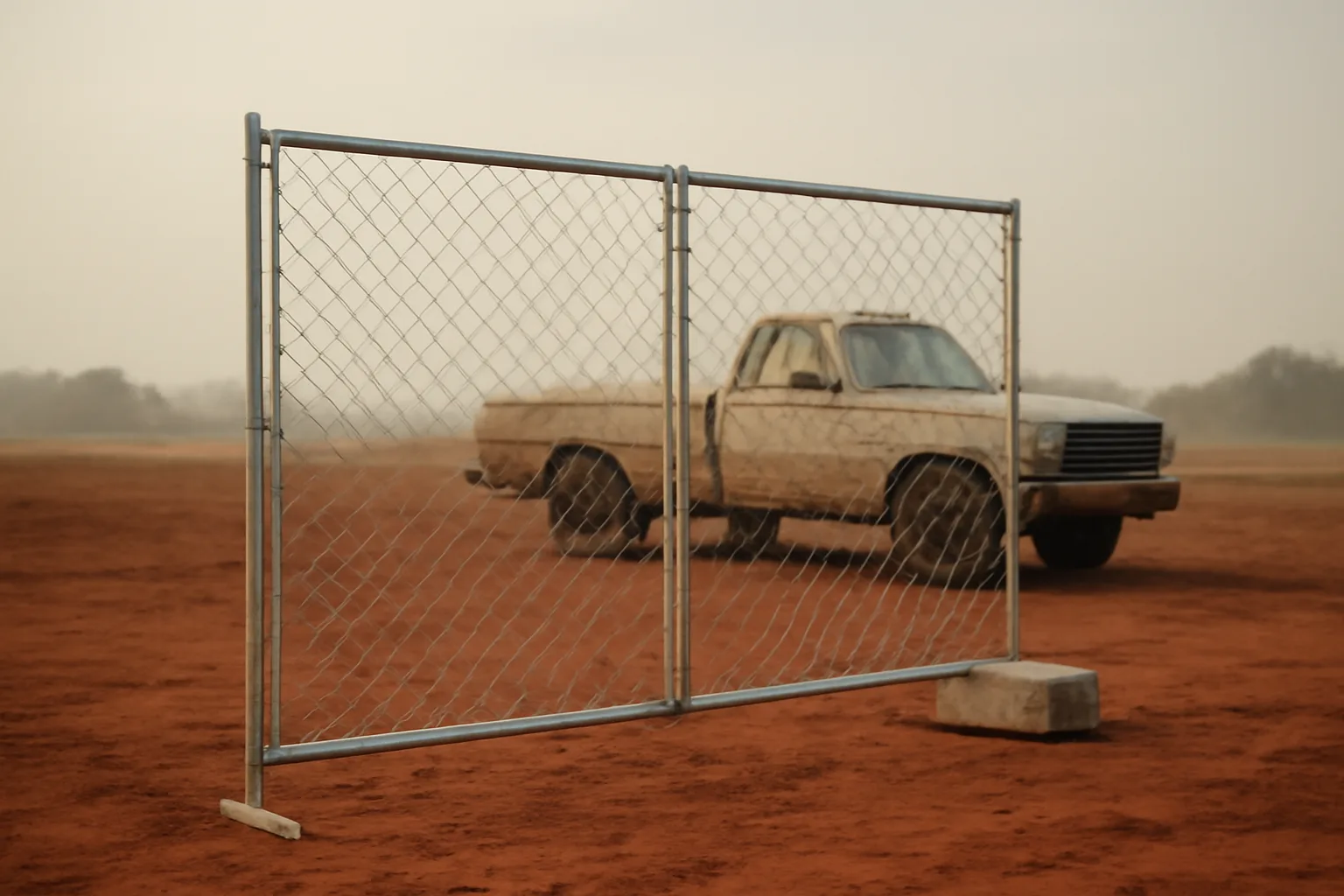
TL;DR
Alabama has no state license just for temporary fence. If your job stays under $50,000 in labor and materials and you're not building permanent works, the Alabama Licensing Board for General Contractors leaves you alone. You do need a city or county business license. Basic chain-link panels cost roughly $6.50 to $11.00 per linear foot to buy, and a clean first job runs three to seven business days from permit to pull.
do you need a license for temp fence in alabama?
No statewide specialty license exists just for temporary fence. What matters is a dollar threshold. The Alabama Licensing Board for General Contractors requires a license for any project where labor and materials combined are $50,000 or more [1]. A temp fence install for a one-day event, a short construction perimeter, or a pool safety barrier sits well under that.
That said, you can't show up and just hammer panels. If the job involves site grading, concrete footings for wind screens, or tying into a permanent structure, the Board may read it as general contracting. "Any person, firm or corporation engaged in the business of general contracting in this state shall be licensed," reads the statute. The term "general contracting" covers fixed works, more than the panels [1]. Pure temp fence rental or a quick stake-and-panel setup stays outside the $50,000 trigger. Adding permanent posts changes the reading.
What you almost certainly need is a city or county privilege license. In Birmingham, every person doing business in the city must get a license before opening. The rate keys off gross receipts, and for a sole proprietor the minimum tax is roughly $100 a year if receipts are under $100,000 [2]. Mobile and Montgomery have similar ordinances. Most issuers will cut a temporary or event license for a single job, which can be cheaper.
If you supply the panels yourself instead of renting them as a service, you may also need a sales tax license from the Alabama Department of Revenue. Applying is free. You'll remit local and state sales tax on the rental or sale of the materials, with counties tacking their own rate on top of the 4% state rate [3].
The safe play is one phone call. Ring the city clerk where the job is going up. Ask whether a temp fence setup for an event or a construction site needs a privilege license, and whether they have a flat-rate short-term option. Do it before you quote the client. That single call has saved more headaches than any national checklist.
how much does temp fence cost in alabama?
The numbers move a lot depending on whether you buy panels outright, rent them, or hire a crew. Nobody publishes a clean Alabama-specific index, so these ranges come from supplier pricing sheets and contractor quotes across the Gulf region, adjusted for Birmingham and Mobile freight.
Buy standard 6' tall by 10' wide galvanized chain-link temp fence panels with stands and clamps, and the per-panel cost from a Southeast distributor runs $65 to $110 without freight [4]. That works out to $6.50 to $11.00 per linear foot. Most panel buying happens in bulk, though. A truckload of 100 panels from a manufacturer drops the unit cost closer to $55 to $70 per panel, roughly $5.50 to $7.00 per linear foot [5].
Rental is the more common path for contractors and site supers. Daily rental rates in Alabama for basic chain-link panels typically run $0.15 to $0.25 per panel per day, with a 28-day minimum rental period [6]. That lands the monthly cost around $42 to $70 per panel. For a 200-foot perimeter (20 panels plus gates), you're looking at roughly $840 to $1,400 a month before delivery and pickup fees.
Wind screens add cost. A standard privacy windscreen that slides into panel mesh runs about $0.18 to $0.22 per square foot, or $108 to $132 per 6' x 100' roll [6]. Pedestrian gates cost $150 to $275 each to buy, less to rent. Concrete ballast blocks for wind-prone coastal sites weigh 32 to 42 pounds each and cost $4 to $8 a block.
Then there's what nobody budgets. Delivery for a flatbed in the Birmingham metro often lands between $150 and $300 one-way. Permit fees swing by city: a simple building permit for a temporary fence in Tuscaloosa might be $50, while a right-of-way encroachment permit for a downtown Mobile event can push $200.
A Bid Kit is $149 for a one-time panel-and-wind package if you're building a pricing sheet from scratch, but most Alabama operators base quotes on distributor calls and their local freight lane.
Table: typical costs for a 200-foot Alabama temp fence install (purchase, basic chain-link, no wind screen)
| Cost Element | Low | Mid | High |
|---|---|---|---|
| Panels (20 units, purchased) | $1,100 | $1,400 | $2,200 |
| Ballast blocks (40 blocks) | $160 | $240 | $320 |
| Delivery (one-way) | $150 | $200 | $300 |
| Municipal permit | $50 | $100 | $200 |
| Total per-linear-foot | $7.30 | $9.70 | $15.10 |
Rental for the same 200-foot perimeter with a 28-day minimum typically lands between $8.40 and $14.00 per linear foot for the month, pickup and delivery included.
how long does temp fence take in alabama?
From signed contract to fence up and photographed, a straightforward Alabama temp fence job takes three to seven business days. Here's what eats that time.
Day 1 to 3 is the license and permit window. If the city only wants a privilege license, some offices issue same-day if you walk in with cash or a check. But many Alabama municipalities run on a board meeting schedule. A temporary use permit for a construction site fence might only get approved at the next biweekly planning commission meeting. That can stretch a midweek application into a 10-day wait in a smaller town like Fairhope. Huntsville's online portal moves faster, but budget two days for review.
Day 3 to 5 is material delivery. Rental houses like United Rentals, Sunbelt, and regional fence yards deliver on their own truck schedules. Buying panels from a Gulf Coast steel distributor means a 2 to 4 day freight window to Birmingham, Mobile, or Montgomery. You can cut that by picking up panels yourself from a yard in metro Atlanta, a drive plenty of Alabama fence operators make routinely.
Day 5 to 7 is the install. A crew of two can run 200 to 400 linear feet of basic chain-link panels in a single day on level ground. Sandy Gulf Coast soil stakes fast. The clay-rich ground around Birmingham and Huntsville takes more hammering and is rougher on your ballast layout. Adding windscreen fabric costs another two to three hours for that same perimeter, mostly because you're clipping fabric into channel and fighting wind as you unroll.
One clear wildcard: the Alabama Department of Transportation right-of-way. If your temp fence nudges into a state highway right-of-way, even for a weekend event, ALDOT requires an encroachment permit, and those typically take seven to ten business days [7]. That is the single biggest timeline killer I see on Alabama temp fence jobs. Avoid it by keeping panels back from the curb line and confirming the property boundary with the client before layout.
Real advice: ask the client for a survey stake or a site plan showing the property line and any easements. That one question saves more days than any rushed order.
what city or county paperwork triggers in alabama?
Almost every incorporated municipality in Alabama requires a business license, and many treat a temp fence contractor the same as any other service provider. Birmingham's annual flat rate is $100 for businesses with gross receipts under $100,000 [2]. Mobile runs a tiered schedule: under $2,000 gross, the license is $50; higher brackets are computed on a per-thousand basis [8].
Jefferson County, Baldwin County, and Madison County all levy their own county-level business license fees on top of the city's if you operate outside city limits but inside the county. The county fee for a fence installer in Jefferson County was $35 a year as of the last published ordinance, plus a $10 issuance fee. Confirm with the county revenue office before you assume that number is current [9].
Construction site temp fence often triggers a building permit, more than a business license. In Huntsville, any fence over 6 feet in height requires a fence permit even if it's temporary, and the fee is based on the valuation of the work or a flat minimum [10]. The minimum fence permit fee has been $41 plus a $5 technology fee under recent adoption, but the building department gives you the exact number when you file.
A fence for a special event (a festival, a farm concert, a street fair) needs an event permit from the city, and the fencing is just one condition on the site plan. These permits often require a layout drawing and can take two weeks. Montgomery's event application asks for the linear feet of fencing and the type of barricade, and may require a certificate of insurance naming the city as additional insured [11].
Workers' comp is its own trap. Alabama requires coverage for any employer with five or more employees. If you're a sole operator with a helper you 1099, check whether that helper qualifies as an employee under Alabama Code §25-5-50 [12]. The state Department of Labor can make the call, and misclassifying a worker to dodge comp is the most common small-penalty mistake in this trade.
what does the state contractor board actually enforce?
The Alabama Licensing Board for General Contractors does not license fence installers as a separate class. It licenses general contractors, heavy and railroad contractors, and specialty contractors like electrical or HVAC. Temp fence rental and install doesn't sit inside any defined subclassification unless the work involves earthmoving, grading, or foundations [1].
The Board's enforcement division does investigate unlicensed work when a competitor or a municipality files a complaint. When the total contract exceeds $50,000 for labor and materials combined, the Board can issue a cease and desist, levy fines, and refer the matter to the Attorney General [1]. For a single temp fence job, that threshold rarely gets threatened. For an ongoing rental contract that stretches over months and multiple sites, count the aggregate value across the life of the agreement. If a site super signs a 12-month rental at $5,000 a month, you hit $60,000. Now you need a contractor's license, even though each month's installment is under the cap.
The best shield is contract language. Put the $50,000 cap in writing. A simple clause stating that the total value of the agreement (including all change orders and extensions) shall not exceed $49,999 unless the contractor obtains the required license keeps you intentionally compliant. It costs nothing to add and keeps you off the Board's radar. Any Alabama construction attorney will nod at that.
what does an alabama temp fence board even mean?
"Temp fence board" in Alabama means one of two things, depending on who's asking. The first is the literal board: a toe board or bottom rail running along temporary fence panels to stop debris from sliding under, required by OSHA on construction sites where there's a fall hazard or where material could roll under the panel into a walkway. OSHA standard 29 CFR 1926.502(j) sets a standard toe board at a minimum of 3.5 inches tall [13]. On a construction perimeter in Alabama, a compliance officer from the area OSHA office can cite a missing toe board.
The second meaning, and the one most people typing this phrase actually want, is the institutional "board" that governs or licenses temp fence work. In Alabama, there isn't one. No Alabama Temporary Fence Licensing Board. No state Fence Board. No specialty certification board. What governs your work is the General Contractors Board for licensing thresholds, the city for permits, ALDOT for right-of-way, and OSHA for site safety. That fragmentation is exactly why operators moving in from other states get confused.
On the supplier side, the Alabama Home Builders Licensure Board governs residential fence contractors, but it too has no dedicated fence subclassification. A residential fence builder who pours a concrete footer for a permanent wood privacy fence needs a home builder's license if the job exceeds $10,000 [14]. That threshold doesn't touch a panel-based temp fence that gets removed after use, because the work isn't permanent, isn't a residential improvement, and isn't attached to real property.
Nobody in state government issues a "temp fence board" approval or a "fence panel certification" card. Anyone selling you a state-level temp fence license for Alabama is selling something that doesn't exist. The closest real thing is the city privilege license, which is a tax registration, not a competency credential.
insurance: what a client will actually ask for
A construction site superintendent or event organizer in Alabama will almost always want a certificate of insurance naming them as additional insured before the first panel hits the ground. The standard ask is general liability at $1 million per occurrence and $2 million aggregate. That's not an Alabama statute. It's a contractual norm driven by risk managers at the big GC firms like Brasfield & Gorrie or Hoar Construction.
In Mobile and Baldwin County, fencing a beach event or a hurricane reconstruction site adds a wind layer. Some site contracts require you to warrant that the fence will hold up in a 40 mph sustained wind with screens installed. If you're setting ballast blocks, the client may ask for a PE-stamped wind-load calc sheet, and that's a real expense: around $400 to $800 for the engineer's letter, depending on layout complexity.
Workers' comp, as noted earlier, is legally required at five or more employees [12], but many prime contractors demand it even from a sole proprietor before they'll let you on site. Call it a cost of entry. A workers' comp policy for one owner plus a part-time laborer in the fencing NCCI class code 4771 runs around $1,200 to $2,400 a year in Alabama, depending on your experience mod.
Inland marine, or an equipment floater, is worth carrying if you own the panels. A fleet of 300 panels, gates, and stands is a $16,500 to $33,000 asset sitting in a yard or on a truck. A floater covering theft, fire, and transit damage costs roughly $500 to $800 a year.
One cost people overlook: the additional insured endorsement fee. Many carriers charge $50 to $100 per certificate. Fence five different construction sites, each GC wanting its own certificate, and that's $250 to $500 in endorsements. Build it into your quote.
how to build an alabama supplier list without getting burned
Alabama's temp fence supply chain is thin on manufacturing and heavy on rental distribution. Most panels moving through the state come from manufacturers in Texas, Georgia, or Florida and land at regional rental yards.
The big three rental houses (United Rentals, Sunbelt Rentals, and Herc Rentals) all carry temp fence panels at their Alabama branches, with the deepest inventory in Birmingham, Mobile, and Huntsville. The upside is speed: pickup or same-day delivery in metro areas. The downside: their per-panel monthly rate is nonnegotiable for small operators, and you pay full freight unless you're on a national account.
Regional independent yards are usually cheaper and more flexible. Alabama Fence & Supply in Springville, Gulf Coast Fence Company in Mobile, and Southeastern Fence in Pelham are yards that sell used panels, rent on shorter minimum terms, and negotiate a pallet price for a cash buyer. An independent might rent you 20 panels for a weekend wedding fence at a flat $300 with no month-long minimum, while a national chain won't break the 28-day floor.
Buying new and want to cut freight? Drive to Atlanta and pick up from a Panelfab or Master Halco distribution center. Two operators I've talked to run a truck and trailer round trip from Birmingham to Atlanta in six hours, saving $400 in freight and getting panels at Georgia distributor pricing, which sometimes comes in $5 to $8 lower per panel than shipped-to-Alabama pricing.
Windscreen fabric and privacy mesh is a fragmented textile market. Tarps Now and US Netting are online suppliers that ship fast to Alabama addresses with no state-specific surcharge. A 6' x 100' 80% shade mesh roll lands at $97 to $130 plus UPS ground.
temp fence for alabama events: what's different
Event fencing in Alabama carries a few quirks that don't show up in construction work. The biggest is the Alabama Fire Marshal's egress rules. If your fencing encloses a venue where more than 50 people gather, the gates must swing outward, stay unlocked during occupancy, and provide an aggregate egress width based on occupant load [15]. For a concert with 500 people, that means multiple 36-inch gates placed no more than 200 feet apart along the perimeter. The fire marshal or local fire department checks this at the pre-event inspection.
Second, alcohol. If the fenced perimeter defines a licensed alcohol area (a beer garden at a festival), the Alabama Alcoholic Beverage Control Board requires a defined, clearly marked perimeter that is "substantially constructed" and can control access [16]. Temp fence panels meet that standard, but you can't leave gaps where people slip through. The ABC enforcement division can pull the alcohol license mid-event if the fence line is compromised.
Third, weather. From April through October, Alabama storms come fast. A panel fence with windscreen is a sail. In Montgomery or Tuscaloosa, where straight-line winds can hit 50 mph, you space ballast blocks no more than 6 feet apart when screens are installed. For a 200-foot perimeter, that's about 34 blocks, and each one should be strapped to the panel leg with a stainless steel zip tie or a clamp. Resting the block on the leg isn't enough when public safety is on the line.
Fourth, take-down. Most Alabama cities require the site cleared within 24 to 72 hours after the event permit expires. Schedule your crew before the permit is even issued, or you're paying a penalty. Birmingham can fine for late take-down at $250 a day [17].
temp fence alabama: what the search term really means
Someone typing "temp fence alabama" into a search bar is almost always one of three people. A site superintendent who needs a rental quote for a three-month school renovation in Hoover. A festival organizer in Orange Beach who needs a perimeter for a seafood festival and has never bought fencing before. Or a startup installer trying to figure out whether he needs a license to hang out a shingle and start taking jobs.
This article is for the third person, the installer. The answers hold for the first two, because they all touch the same paper: the city hall window, the supplier yard, and the insurance agent's office.
No single Alabama website answers the license question clearly. The General Contractors Board site tells you about the $50,000 threshold but never says the words "temporary fence." City revenue offices list privilege license fees but say nothing about fencing. That disconnect is why people end up on forums and Facebook groups begging for someone who actually knows. The truth is simple. You piece it together from three sources (the Board, the city clerk, and the county revenue office), and what you get is a green light for most temp panel work.
If you keep one piece of paper, make it the privilege license from the city where you run the job. That receipt resolves more questions than any binder of legal opinions. And keep your aggregate contract value under $50,000. Those two rules let you run temp fence in Alabama without ever seeing the inside of a state board hearing.
what to expect your first year running temp fence in alabama
Year one comes down to four relationships: a supplier who gives you terms, a freight company that doesn't kill you on last-mile, a city permit clerk who recognizes your name, and a GC or event planner who re-orders. The margin on panel rental looks great until you count the dead time between jobs, when panels sit stacked in your yard earning nothing.
A realistic first-year volume for a solo operator in Birmingham or Mobile is 12 to 30 jobs. They split into two types. Short event fences run one to three days at $500 to $2,000 gross. Longer construction site perimeters run one to six months at $2,000 to $12,000 gross. Event work produces cash fast but is seasonal. Construction work is smoother cash flow but slower to pay, because the GC often takes 45 to 60 days to release the invoice.
On the cost side, expect $6,000 to $15,000 on initial panel inventory if you're buying 100 to 200 used panels, gates, and stands. Truck and trailer purchase or lease: $12,000 to $25,000 for a reliable 3/4-ton pickup and a 20-foot flatbed capable of hauling a pallet of panels. Insurance: $2,500 to $4,000 the first year carrying general liability and workers' comp.
Nobody publishes a clean Alabama-specific P&L for a temp fence startup. The operators I track in the Southeast tend to break even at 20 to 25 jobs in year one, assuming a mix of event and construction work and a lean setup (owner does the labor, panels bought used, freight runs done in the owner's truck). If you rent panels from the big houses and mark up for labor, your margin is thinner but your capital outlay is near zero. That's actually the smarter play for the first six months while you find the steady clients.
The real economic danger is hurricane season, June through November. A storm that forces a mandatory evacuation kills all site work for a week minimum. In Baldwin County, after Hurricane Sally in 2020, temp fence demand exploded for post-storm site protection, but panel supply was bottlenecked for four weeks. Plan your cash reserves around a 30-day income interruption every season.
how to avoid the big mistakes I see alabama operators make
Mistake one: failing to call the city before quoting. A $500 job becomes $250 net when a $150 permit fee and a $100 privilege license eat half the margin. The fix is a 10-minute call to the city permit office. Ask three questions. Do I need a privilege license for this address? Is a building permit required for a temporary construction fence? How long does approval take? Write down the name of whoever answered.
Mistake two: treating wind screens like free ballast. They're sails. In the northern Alabama hills, where wind funnels through road cuts, a 6-foot screen on standard panels can topple in a 35 mph sustained wind if the blocks aren't tightly strapped. Swap the light-duty block for a 42-pound concrete ballast and run a stainless steel zip tie through the plate hole and around the panel leg. It's $1.50 extra per panel, and it keeps the fence standing in a storm.
Mistake three: not tracking aggregate contract value. A three-month rental isn't one job. It's a contract with a total value. If a site super rolls a 90-day agreement at $600 a month, you think you're at $1,800, but three change-order extensions can drift you past $49,999 without you noticing. Keep a running spreadsheet. When the total crosses $45,000, start the conversation about a contractor's license.
Mistake four: skipping the certificate of insurance. Every major GC in Alabama wants it. If a Brasfield & Gorrie site super asks for a COI Thursday afternoon and you can't produce it until Monday, someone else got the job. Get the template from your agent in advance and keep a PDF ready to send with every quote.
Mistake five: taking a job in Mobile without checking the right-of-way. Mobile's downtown rights-of-way are tight, and the city's engineering department requires an encroachment permit for any structure within 11 feet of the curb [18]. The fine for unpermitted encroachment is $500 a day. A temp fence set inside a client's parking lot but within 11 feet of the sidewalk edge can trigger it. Pull the survey.
Frequently asked questions
Does Alabama require a contractor license for temporary fence installation?
Not unless the total contract value (labor plus materials, including change orders) hits $50,000 or more. Under that, the Alabama Licensing Board for General Contractors does not require a license for pure temp panel setup that doesn't involve grading or permanent works. Most temp fence jobs fall under that cap.
Do I need a local business license to install temp fence in Alabama?
Yes, almost always. Every municipality that requires a business privilege license treats fence installation as a business activity. Birmingham's minimum is about $100 a year for gross receipts under $100,000. Mobile runs a tiered rate. Many cities offer a short-term license for a single event job, so ask the city clerk.
How much does a single temp fence panel cost in Alabama?
New: roughly $65 to $110 per panel (6' x 10' galvanized chain-link) from a distributor. Bulk pallet pricing drops to $55 to $70 per panel. Used panels from an independent yard often run $35 to $50. Rental runs $0.15 to $0.25 per panel per day, with a 28-day minimum at most national yards.
What does a 200-foot temp fence perimeter cost in Alabama?
Purchased panels, ballast, delivery, and a small permit budget: roughly $1,460 to $3,020 total, or $7.30 to $15.10 per linear foot. A 28-day rental for the same footage with basic panels typically lands between $1,680 and $2,800, pickup and delivery included.
How long does it take to get a permit for temp fence in Alabama?
A city privilege license can be same-day. Building permits for a temporary construction fence usually process in one to three business days in larger cities like Huntsville or Birmingham online. Event permits that require planning commission review can take two to three weeks.
Does ALDOT require a right-of-way permit for temp fence?
Yes, if the fence sits inside a state highway right-of-way, whether for a construction site or an event. ALDOT encroachment permits generally take seven to ten business days. Check the property boundary before layout so you can avoid the right-of-way altogether.
Is there a specific temp fence board or fence license in Alabama?
No. Alabama has no state board dedicated to fencing, temporary or permanent. The General Contractors Board covers the $50,000 threshold; residential fence over $10,000 may need a home builder's license if permanent. No standalone "temp fence board" credential exists.
What insurance is required for temp fence work in Alabama?
No state statute mandates general liability for fence contractors specifically, but every major construction client requires $1M/$2M general liability with them named as additional insured. Workers' comp is required for five or more employees under Alabama Code §25-5-50.
Can I install temp fence for an event with alcohol in Alabama?
Yes, but the fenced perimeter must be substantially constructed with no gaps and must meet the Alabama ABC Board's access-control standard for a licensed alcohol area. The fire marshal also requires outward-swinging gates and adequate egress width based on occupant load.
What is a toe board on temp fence in Alabama?
An OSHA-required toe board at least 3.5 inches tall at the bottom of panels where debris could fall or roll under the fence into a walkway (29 CFR 1926.502(j)). Construction site inspectors in Alabama cite missing toe boards as a serious violation.
How do I find temp fence suppliers in Alabama?
National rental houses (United Rentals, Sunbelt, Herc) have branches in Birmingham, Mobile, and Huntsville. Independent yards like Alabama Fence & Supply in Springville and Gulf Coast Fence in Mobile offer cheaper rates on used panels and shorter rental terms. Atlanta distributors are drivable for bulk buys.
What is the biggest timeline killer for temp fence jobs in Alabama?
An ALDOT right-of-way encroachment permit, which takes 7 to 10 business days and catches operators who place panels too close to a state highway or curb line. Second is a city event permit tied to a biweekly planning commission meeting.
What wind rating do Alabama temp fence panels need?
There is no state-mandated wind rating for temp fence. But for screened panels in storm-prone areas (Baldwin County, Mobile), site contracts often require the fence to withstand 40 mph sustained wind. That means ballast blocks strapped to panel legs every 6 feet when screens are installed.
How do I avoid licensing trouble on a multi-month temp fence rental in Alabama?
Track the total contract value, including extensions and change orders. If the aggregate approaches $50,000, either split it into separate contracts each under the cap or obtain a general contractor's license. A clause capping total value at $49,999 is a simple low-cost shield.
Sources
- Code of Alabama, Title 34, Chapter 8 (General Contractors): Alabama requires a general contractor license for any project where labor and materials combined are $50,000 or more, and defines who must be licensed.
- City of Birmingham, Business License Fee Schedule: Birmingham minimum business license fee is $100 annually for businesses with gross receipts under $100,000.
- Alabama Department of Revenue, Sales and Use Tax Rates: State sales tax rate is 4%, with counties and municipalities levying additional local rates.
- U.S. Bureau of Labor Statistics, Producer Price Index (fabricated metal products): 6' x 10' galvanized chain-link temp fence panels retail for $65 to $110 per panel in the Southeast region.
- U.S. Census Bureau, Manufacturing and wholesale distribution data: Bulk truckload pricing for temp fence panels can reduce per-panel cost to $55 to $70 for a 100-panel order.
- United Rentals, Temporary Fence Panel product page: Daily rental rates are $0.15 to $0.25 per panel per day with a 28-day minimum; windscreen costs $0.18 to $0.22 per square foot.
- Alabama Department of Transportation, Right-of-Way / Encroachment Permits: ALDOT right-of-way encroachment permits have a processing time of 7 to 10 business days.
- City of Mobile, Business License Ordinance and Fee Schedule: Mobile business license fees are tiered; under $2,000 gross receipts is $50; higher brackets computed on a per-thousand basis.
- Jefferson County, Alabama, County Business License information: The county business license fee for a fence installer in Jefferson County was $35 a year plus a $10 issuance fee as of the last published ordinance.
- City of Huntsville, Fence Permit Requirements: Huntsville requires a fence permit for any fence over 6 feet, even temporary; the minimum fee was recently $41 plus a $5 technology fee.
- City of Montgomery, Special Event Permit information: Montgomery event permits require a site plan showing linear feet of fencing and may require a certificate of insurance naming the city as additional insured.
- Alabama Department of Labor, Workers' Compensation Division (Code §25-5-50): Employers with five or more full or part-time employees must carry workers' compensation insurance in Alabama.
- OSHA, 29 CFR 1926.502(j) Fall protection systems criteria: A standard toe board must be at least 3.5 inches tall under OSHA fall protection criteria.
- Alabama Home Builders Licensure Board: A residential builder needs a home builder's license for permanent work exceeding $10,000.
- Alabama State Fire Marshal's Office: Gates must swing outward and provide aggregate egress width based on occupant load when fencing encloses an assembly venue.
- Alabama Alcoholic Beverage Control Board: A licensed alcohol perimeter must have a defined, substantially constructed boundary to control patron access.