Last updated 2026-08-18
TL;DR
Texas has no statewide contractor license for temporary fence installation. You still need a registered business entity, general liability insurance, and city or county permits on most jobs. First-year startup costs run $15,000 to $60,000 depending on panel inventory. The licensing gap is real, but local rules vary enough that you must check each job's municipality before you bid.
Do you need a license for temp fence in Texas?
No state contractor license covers temporary fence in Texas. The Texas Department of Licensing and Regulation (TDLR) publishes the trades it regulates, and temporary fence installation is not one of them [1]. That's different from permanent fence, and different from most of the trades that surface when people Google "do I need a contractor license in Texas."
"No state license" is not the same as "no paperwork." Here's what you actually need:
- A registered business entity with the Texas Secretary of State (LLC or corporation) or a properly filed assumed name (DBA) if you're a sole proprietor [2]
- A sales tax permit from the Texas Comptroller if you rent or sell tangible personal property, which panels and accessories qualify as in most contexts [3]
- General liability insurance, because clients require it and because job-site indemnification clauses are standard in Texas construction contracts
- City or county right-of-way permits any time your fence sits in a public right-of-way, which is common on road construction and event jobs
Some Texas cities run their own contractor registration programs. Austin, Houston, and Dallas all have permit systems that may want a registration number before the city issues a fence permit. Confirm current requirements directly with each city's building or public works department before bidding. These change, and no third-party source stays current in real time.
The TDLR list of regulated occupations is public and searchable [1]. Bookmark it. It's the fastest way to check whether anything in your business model (flagging, traffic control devices, electrical connections to site lighting) crosses into a licensed trade.
What business entity should you form first?
Most small temp fence operators in Texas start as a single-member LLC. The Texas Secretary of State charges $300 to file a Certificate of Formation for a domestic LLC under the current fee schedule [2]. That's a one-time cost. Texas has no annual report fee for LLCs, which is a real advantage over states like California or Colorado.
If you're buying equipment before the LLC is approved, don't. Put nothing in your personal name that you intend to be a business asset. The formation runs online through the Secretary of State's SOSDirect portal.
After the LLC is filed, open a business checking account right away. Commingling personal and business funds is the fastest way to lose the liability protection the LLC gives you. Banks will ask for your Certificate of Formation and your EIN from the IRS. Getting an EIN is free at IRS.gov [4].
Planning to operate under a name other than your LLC's legal name? Say the LLC is "Smith Industries LLC" but you want to do business as "Lone Star Temp Fence." File an Assumed Name Certificate with the county clerk in every county where you'll do business [2]. Texas requires this. Skipping it creates headaches when you try to open a bank account or sign a contract under the trade name.
What insurance does a Texas temp fence company need?
General liability is the baseline. Most general contractors in Texas require subcontractors to carry at least $1 million per occurrence / $2 million aggregate before they'll allow you on site. Some oil-field and energy-sector clients want $5 million, so know your market before you buy a policy.
Commercial auto covers your delivery trucks. In Texas, the state minimum liability limits for commercial vehicles are set by the Texas Department of Insurance, but those minimums almost always fall below what your clients require. Match client specs, not state minimums [5].
If you hire employees from day one, Texas is the one state where workers' compensation is not mandatory for most private employers [5]. That surprises people. You can opt out and self-insure or go without. In practice, many GCs require subs to carry workers' comp or sign an opt-out notice. Read your subcontractor agreements carefully.
Tools and equipment coverage (inland marine) protects your panels, bases, and braces while they're in the field or in transit. Operators underbudget this constantly. A 200-panel inventory at $35 to $50 per panel replacement cost is $7,000 to $10,000 in equipment exposure before you count bases and fittings.
Expect to pay $2,500 to $6,000 per year for a basic GL plus commercial auto package when you're starting out. Quotes swing hard on your vehicle count, payroll, and loss history. Get at least three.
How much does temp fence cost in Texas?
Two cost questions live here: what it costs to start the business, and what it costs customers to rent panels.
Startup costs
The table below gives realistic ranges based on common equipment prices and business formation costs. These aren't quotes. They're planning benchmarks.
| Item | Low estimate | High estimate |
|---|---|---|
| LLC formation (TX SOS fee) | $300 | $300 |
| EIN + registered agent (first year) | $0 | $150 |
| Used truck or trailer | $8,000 | $25,000 |
| 100-panel starter inventory | $4,500 | $9,000 |
| Bases, clamps, and bracing | $1,200 | $3,500 |
| Insurance (first year) | $2,500 | $6,000 |
| Sales tax permit + accounting setup | $0 | $500 |
| Total | $16,500 | $44,450 |
Panel pricing in Texas moves with steel market conditions. New 6-foot by 10-foot chain-link panels from US suppliers have ranged from $55 to $110 per panel in recent years depending on gauge and vendor. Used panels in good shape often go for $35 to $60 each. Watch local equipment auctions, especially in Houston and Dallas, for panel lots from retiring operators.
What you can charge customers
Rental rates in Texas markets generally land in the $3.50 to $6.00 per linear foot per month range for standard chain-link temp fence with no screen, based on contractor rate sheets circulating in the Houston and DFW markets. Wind screen adds $1.50 to $3.00 per linear foot. Delivery, installation, and pickup are almost always billed separately, often as a flat trip fee plus a per-panel labor rate.
Oil-field and pipeline work in West Texas and the Permian Basin tends to command higher rates because of longer hauls and remote-site premiums. Event fence in Austin and San Antonio turns faster and can be priced at a premium per event versus monthly rental.
Nobody publishes a definitive Texas temp fence rate survey. The ranges above reflect industry conversations and public bid tabs on government projects, but your local market will differ. Do your own comp check by getting three competitor quotes on a real job before you set your rate card.
How long does temp fence take in Texas, start to first job?
From zero to operating, a realistic Texas timeline runs three to four weeks on the paperwork, with equipment as the wild card. Here's the breakdown:
- LLC formation: 3 to 7 business days via the Secretary of State's online SOSDirect portal for standard processing. Expedited processing (24-hour turnaround) costs an extra $25 [2].
- EIN from IRS: Immediate if you apply online during IRS business hours. The online application issues EINs instantly [4].
- Business bank account: 1 to 3 days once you have your LLC paperwork and EIN in hand.
- Insurance: 1 to 5 days to quote and bind coverage.
- Sales tax permit (Texas Comptroller): Usually 2 to 3 weeks for a paper application; the online application can be faster, but processing times vary [3].
- Equipment acquisition: This is your actual bottleneck. Buying used panels locally, you could move in days. Ordering new panels from a manufacturer with production lead times, expect 4 to 12 weeks.
A motivated operator who lines up equipment locally can be legally operating and bidding within three to four weeks of starting. The sales tax permit may arrive after your first job, which is fine as long as you're collecting and remitting properly from the start.
Permit timelines on the job side are separate. A right-of-way permit from a Texas city can take anywhere from same-day over the counter to three or four weeks depending on the municipality and workload. Build permit lead time into every bid that involves public right-of-way.
What permits do Texas municipalities require for temp fence jobs?
This is where Texas gets messy. The state sets no universal permit requirement for temp fence, so every city and county does it differently.
Houston has famously minimal zoning, but inside city limits and in the extraterritorial jurisdictions (ETJs) of most major Texas cities, you'll hit permit requirements. The City of Houston requires permits for work in the public right-of-way, which includes sidewalks and street lanes adjacent to construction sites [6].
Dallas requires a fence permit for temporary construction fencing in the public right-of-way, processed through Dallas Development Services [7].
Austin routes right-of-way work through the Austin Transportation and Public Works Department, and event-related fence often needs a special event permit through the City Clerk's office on top of any right-of-way permit.
The practical move: before you price any job, call the city's public works or development services department and ask two questions. First, do I need a permit to install temporary chain-link fence at this address? Second, do I as the contractor need any city registration number to pull that permit? Both answers change your bid.
For jobs entirely on private property (a vacant lot, a construction site with no public right-of-way involvement), permit requirements drop sharply. Confirm with the property owner and the GC that the site boundary is clear.
How do you find your first temp fence customers in Texas?
General contractors are your primary customer in the early months. Get on as many GC subcontractor lists as you can. Every major Texas GC, including Turner, Hensel Phelps, Austin Industries, and Zachry Group, runs a subcontractor prequalification portal. Submit to as many as you can before you have equipment in hand.
Texas has an enormous public bid market. The Texas Comptroller's Electronic State Business Daily (ESBD) publishes state agency opportunities [8]. TxDOT bids run through its own vendor portal. Cities like Houston, San Antonio, and Dallas post bid opportunities on their own procurement sites. Many of these jobs specify temp fence as a line item inside a larger construction bid, so you're often selling as a sub, not a prime.
The Permian Basin is its own category. Midland and Odessa construction tied to oil-field infrastructure generates steady demand for site security fence. The distance from major population centers creates a supply gap that a well-equipped operator can fill with a real rate premium.
Word of mouth in Texas construction moves fast. Show up on time, pull your fence on the day it's supposed to come out, and don't leave gates hanging open. Those three habits will get you more referrals than any marketing spend in your first year.
Want a starting framework for your first panel bid? The TempFencePath Panel + Wind + PW Bid Kit at $149 one-time covers the quoting templates and per-foot calculations that eat the most time to build from scratch.
What equipment do you actually need to start?
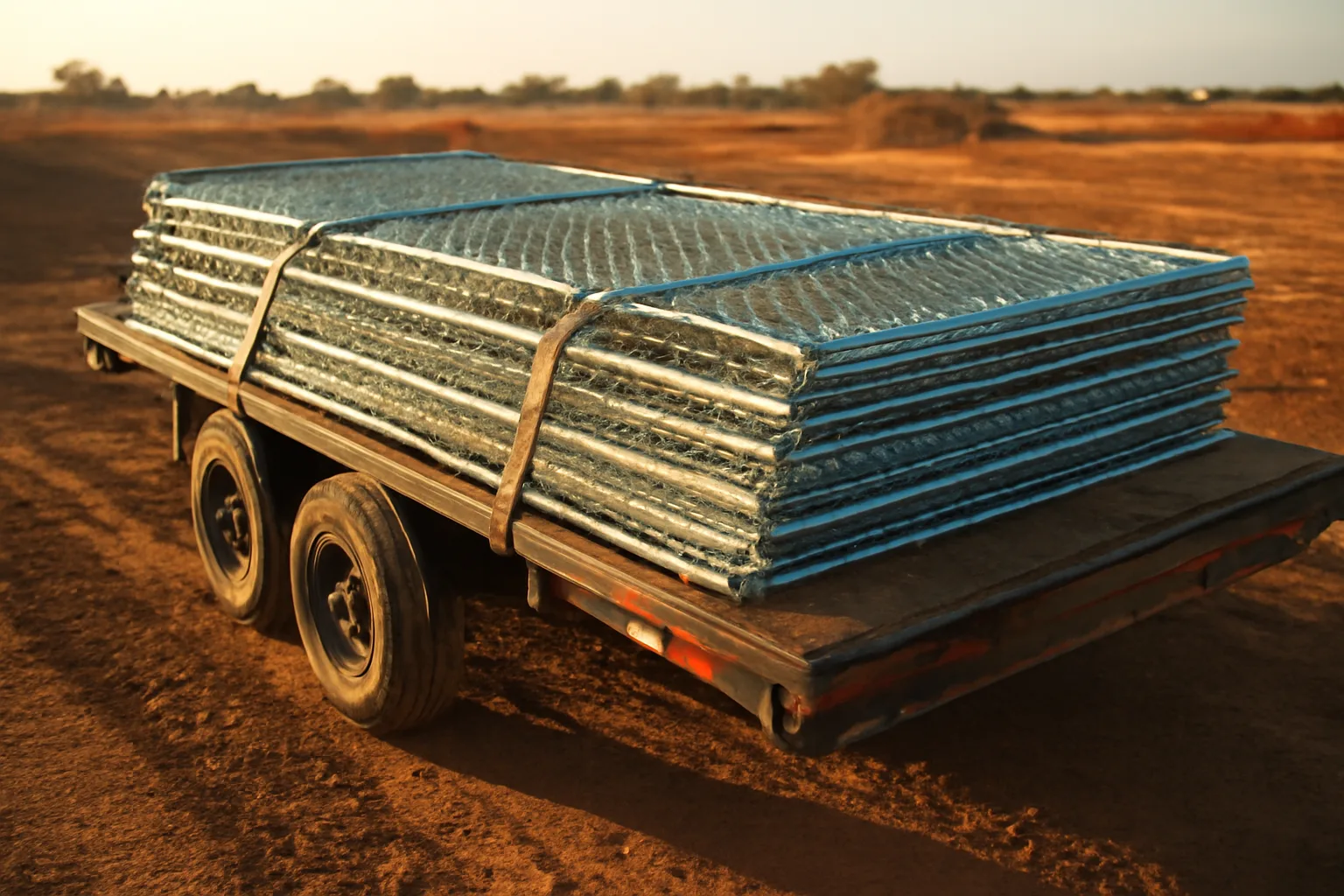
The minimum viable rig for a Texas temp fence startup is a truck rated to tow your load and a trailer. A gooseneck or bumper-pull flatbed in the 16-to-20-foot range holds 50 to 80 panels comfortably depending on how you stack. You don't need a dedicated panel truck to start, but you'll want one by the time you're managing more than 300 panels in the field.
Panel inventory: 100 panels is a functional minimum. It lets you bid jobs up to 1,000 linear feet with panels rented at roughly 10 linear feet each (accounting for overlaps). You'll hit the ceiling fast if you land a single large job, so keep a rental relationship with another operator or a national supplier in your back pocket from day one.
Bases and bracing: plan one base per panel plus 15 to 20 percent overage for loss, damage, and jobs that need denser base placement. Wind bracing (X-bracing or tension cables for high-wind setups) is standard in Texas, where sustained coastal and Panhandle winds regularly top 40 mph. Budget the same quantity of braces as panels.
Hand tools: a panel cart or pallet jack for loading and unloading, bolt cutters, fence pliers, and a torque driver for hinge pins. Nothing exotic.
You do not need a forklift to start. Many early operators unload manually or rent a skid-steer by the hour from a local equipment yard. Buy a forklift when the volume justifies the capital and the storage cost.
How do Texas wind and weather conditions affect your fence setup?
Texas is one of the more demanding states for temporary fence engineering. The Gulf Coast sees tropical storm and hurricane-force gusts. The Panhandle and West Texas run sustained high winds year-round. Central Texas gets spring severe weather with very fast-moving fronts.
The International Building Code, which most Texas jurisdictions adopt with local amendments, has provisions for temporary structures in high-wind zones [9]. Texas spans several ASCE 7 basic wind speed zones depending on location, running from roughly 90 mph inland to 130 mph or higher along the Gulf Coast [10].
In practical terms: on a Gulf Coast or coastal bend job, your standard base-and-panel setup isn't enough for a sustained storm. Wind screen multiplies the load on bases by a factor of three to five compared to open chain-link. Use sandbags, water-ballast bases, or X-brace every third panel minimum. On event jobs near the coast, you should be able to strip fence fast if a storm approaches, so design for rapid breakdown.
Knowing your county's design wind speed and being able to explain your bracing to a GC's site superintendent is a real competitive edge. Most of your early competitors can't have that conversation. See the ASCE 7 wind map and your county's adopted building code for the applicable design values [10].
What does your first-year operation really look like financially?
Honest answer: year one is mostly about covering fixed costs while you build the customer base. Here's a rough income model for a 100-panel startup.
If 60 panels are out on rent at any given time (60% utilization) at $4.50 per linear foot per month, and each panel is 10 linear feet, that's 600 linear feet times $4.50 equals $2,700 per month in rental revenue. Add delivery and install fees: average $400 per trip across 8 jobs per month, and that's another $3,200. Gross monthly revenue approaches $5,900.
Against that: insurance ($250 to $500 per month), truck payment or depreciation ($500 to $800), fuel ($300 to $600), phone, software, and miscellaneous ($150 to $300). That's $1,200 to $2,200 per month in fixed overhead before you pay yourself.
At 100 panels you can be profitable in the first year, but you won't get rich. The model scales faster once you cross 300 panels and can service multiple simultaneous jobs without redeploying the same inventory.
The real wealth in temp fence sits in the panel inventory. Panels bought at $40 each and rented out repeatedly at $4.50 per linear foot pay back their cost in roughly 9 to 15 months at realistic utilization. After that, the panel is pure gross margin until it's damaged or stolen. Buy panels aggressively with your early profits and hold them. That's the actual business model.
For how neighboring states structure similar startups, see how to start temp fence in Colorado or how to start temp fence in Arizona, both with licensing structures that contrast sharply with Texas.
What are the common mistakes new Texas temp fence operators make?
Underpricing delivery is the most expensive one. New operators fixate on the per-foot rental rate and forget that a two-hour round trip plus 45 minutes of load and unload costs real money. Charge $250 delivery on a 200-linear-foot job that takes four hours of total labor, and you've lost money on the service component even if the rental rate looks fine.
Buying panels without a way to store them is a close second. Texas heat is hard on rubber base feet and on any plastic-coated accessories. Store your panels in a muddy field and they'll show up on site filthy, and your GC will notice. A gravel lot or a covered bay is worth the rent.
Skipping the sales tax permit and assuming rentals aren't taxable. Texas taxes the rental of tangible personal property [3]. Fence panels are tangible personal property. Collect sales tax from day one or you'll owe it personally later.
Ignoring the contract. A one-page rental agreement that spells out the rental period, the per-panel rate, who's responsible for damage, and what happens to abandoned panels is not optional. Use one from the first job. Texas courts enforce written contracts. You'll want one in hand when a customer decides not to pay and you have to file in small claims court.
Taking a job in a market you don't know without checking local permit rules first. Show up to install fence in downtown Austin without a right-of-way permit, get the job stop-worked, and you've burned a GC relationship you spent months building.
Frequently asked questions
Do you need a contractor license for temp fence in Texas?
No. Texas does not require a statewide contractor license specifically for temporary fence installation. The Texas Department of Licensing and Regulation lists all regulated trades and temp fence isn't among them. You do need a registered business entity, a sales tax permit from the Texas Comptroller, and general liability insurance. Some cities require a contractor registration number before issuing permits, so confirm requirements locally.
How much does it cost to start a temp fence company in Texas?
A realistic first-year startup ranges from about $16,500 on the low end (used panels, used trailer, minimal inventory) to $45,000 or more if you buy new equipment. The LLC formation fee is $300 with the Texas Secretary of State. Insurance runs $2,500 to $6,000 per year. Panel inventory is the largest variable: plan $35 to $110 per panel depending on condition and source.
How long does it take to get a temp fence business set up in Texas?
The legal and administrative side takes three to four weeks: LLC formation runs 3 to 7 business days (or 24 hours expedited), the IRS EIN is instant online, and the Texas sales tax permit takes two to three weeks by the Comptroller's typical processing time. Equipment is usually the real bottleneck. Used panels acquired locally can get you operational in under a month; new panel orders can take 4 to 12 weeks.
Does Texas require a sales tax permit to rent out temp fence panels?
Yes. Texas taxes the rental of tangible personal property, and fence panels qualify. Register with the Texas Comptroller's office before your first rental transaction. The registration is free. If you collect sales tax without a permit, or fail to collect it and get audited, you are personally liable for the unpaid tax. The Comptroller's online registration is the fastest route.
Do Texas cities require permits for temporary construction fence?
Most major Texas cities, including Houston, Dallas, and Austin, require a permit when temporary fence is installed in or adjacent to a public right-of-way. Private property jobs with no right-of-way involvement typically don't require a city fence permit. Requirements vary city to city and change periodically, so call the public works or development services department for every job location before you bid.
Is workers' compensation required for a Texas temp fence business?
Texas is the only state where workers' compensation insurance is not mandatory for most private employers. You can legally opt out. However, many general contractors require subcontractors to either carry workers' comp or sign a specific opt-out notice before they can work on site. Read your subcontractor agreements carefully. If a worker is injured and you have no coverage, your liability exposure is significant.
What type of insurance do I need for a temp fence business in Texas?
At minimum: general liability insurance (most GCs require $1 million per occurrence / $2 million aggregate), commercial auto insurance for your delivery trucks, and tools and equipment coverage (inland marine) for your panel inventory. Oil-field and energy clients sometimes require $5 million GL. Workers' comp is optional under Texas law but often required by contract. Budget $2,500 to $6,000 per year for a basic package when starting out.
How do I find my first temp fence customers in Texas?
Submit to GC subcontractor prequalification portals as early as possible, before your equipment arrives if you can. Monitor the Texas Comptroller's Electronic State Business Daily for public construction bids. TxDOT projects list temp fence as a line item routinely. The Permian Basin market in Odessa and Midland has consistent demand from oil-field construction. Personal referrals from GC site superintendents move faster than any advertising in the first year.
How many panels do you need to start a temp fence business in Texas?
One hundred panels is a workable minimum for a solo operator. That covers jobs up to roughly 1,000 linear feet. At 60 percent average utilization, 100 panels generates enough rental revenue to cover basic overhead. Most operators who stay in the business past year two grow to 300 or more panels. Have a backup source, either a national supplier or a local operator willing to sub-rent, for jobs that exceed your inventory.
What does temp fence rental cost in Texas per linear foot?
Standard chain-link temporary fence rents in the range of $3.50 to $6.00 per linear foot per month in most Texas markets. Wind screen adds $1.50 to $3.00 per linear foot. Delivery, installation, and pickup are billed separately, typically as a flat trip fee plus per-panel labor. Remote locations in West Texas or the Permian Basin often command higher rates due to distance and limited local competition.
Do I need a special license for temp fence with wind screen in Texas?
No separate license applies specifically to wind screen installation in Texas. Wind screen is treated as an accessory to the panel rental. That said, wind screen dramatically increases the wind load on your base and bracing system. In coastal Texas counties with high design wind speeds, you need to configure bracing appropriately. Know your county's adopted wind speed zone under ASCE 7 and be able to explain your setup to site supervisors.
Can I run a temp fence business from home in Texas?
You can legally register a Texas LLC with a home address and operate from there. The practical problem is panel storage. Storing hundreds of metal fence panels in a residential driveway or backyard may violate local zoning ordinances or HOA rules. Most operators rent a gravel lot or small yard space as soon as inventory grows past 50 to 100 panels. Check your city's zoning rules for commercial storage in residential zones before you commit to a home-based model.
How is starting a temp fence business in Texas different from states like California or Colorado?
Texas has no statewide contractor license for temp fence and no annual LLC report fee, which reduces both administrative burden and recurring cost. California requires a C-13 fencing contractor license for most fence work and has significantly higher compliance overhead. Colorado has no fence-specific license but has different entity formation and sales tax rules. The Texas model is among the more startup-friendly in the country for this specific trade.
Sources
- Texas Department of Licensing and Regulation: Temporary fence installation is not among the trades regulated by the Texas Department of Licensing and Regulation.
- Texas Secretary of State, Business Organizations Filing Fees: The Texas Secretary of State charges $300 to file a Certificate of Formation for a domestic LLC; expedited 24-hour processing costs an additional $25.
- Texas Comptroller of Public Accounts, Sales and Use Tax: Texas taxes the rental of tangible personal property, which includes fence panels rented to customers.
- Internal Revenue Service, Apply for an Employer Identification Number (EIN) Online: The IRS issues EINs immediately via the online application during business hours, at no cost.
- Texas Department of Insurance, Workers' Compensation: Texas is the only state where workers' compensation insurance is not mandatory for most private employers.
- City of Houston Permitting Center: The City of Houston requires permits for work in the public right-of-way, including temporary fence adjacent to construction sites.
- Texas Comptroller of Public Accounts, Electronic State Business Daily (ESBD): The Texas Comptroller's Electronic State Business Daily publishes state agency procurement opportunities, including construction contracts that specify temporary fence.
- International Code Council, International Building Code 2021, Chapter 31 (Special Construction): The International Building Code includes provisions for temporary structures in high-wind zones, adopted with local amendments by most Texas jurisdictions.
- ASCE 7-22, Minimum Design Loads and Associated Criteria for Buildings and Other Structures: Texas has multiple ASCE 7 basic wind speed zones, ranging from about 90 mph inland to 130 mph or higher along the Gulf Coast, affecting temporary fence bracing requirements.